Inherited Family Media: What to Preserve First
A practical guide to navigating the emotional and logistical challenge of preserving inherited family media
Contents
The Box in the Closet Nobody Knows What to Do With
In addition to the above list, most people have at least one “Box in the Closet Nobody Knows What to Do With.” This type of space fills up with various items that simply have nowhere else to go in the home.
The stuff of other people. Typically someone has inherited all of the items of a family member or other friend. They may also be someone who inherited a house with boxes and storage bins full of hoarded items. This scenario begins with someone wanting to clean out a dusty and cobweb covered basement, storage shed, or attic. They drag out a few boxes and then someone else has to agree to help them sort through them. Typically, the person who is going to do the sorting is quite reluctant to begin the process. That is because the items in the boxes are their stuff.
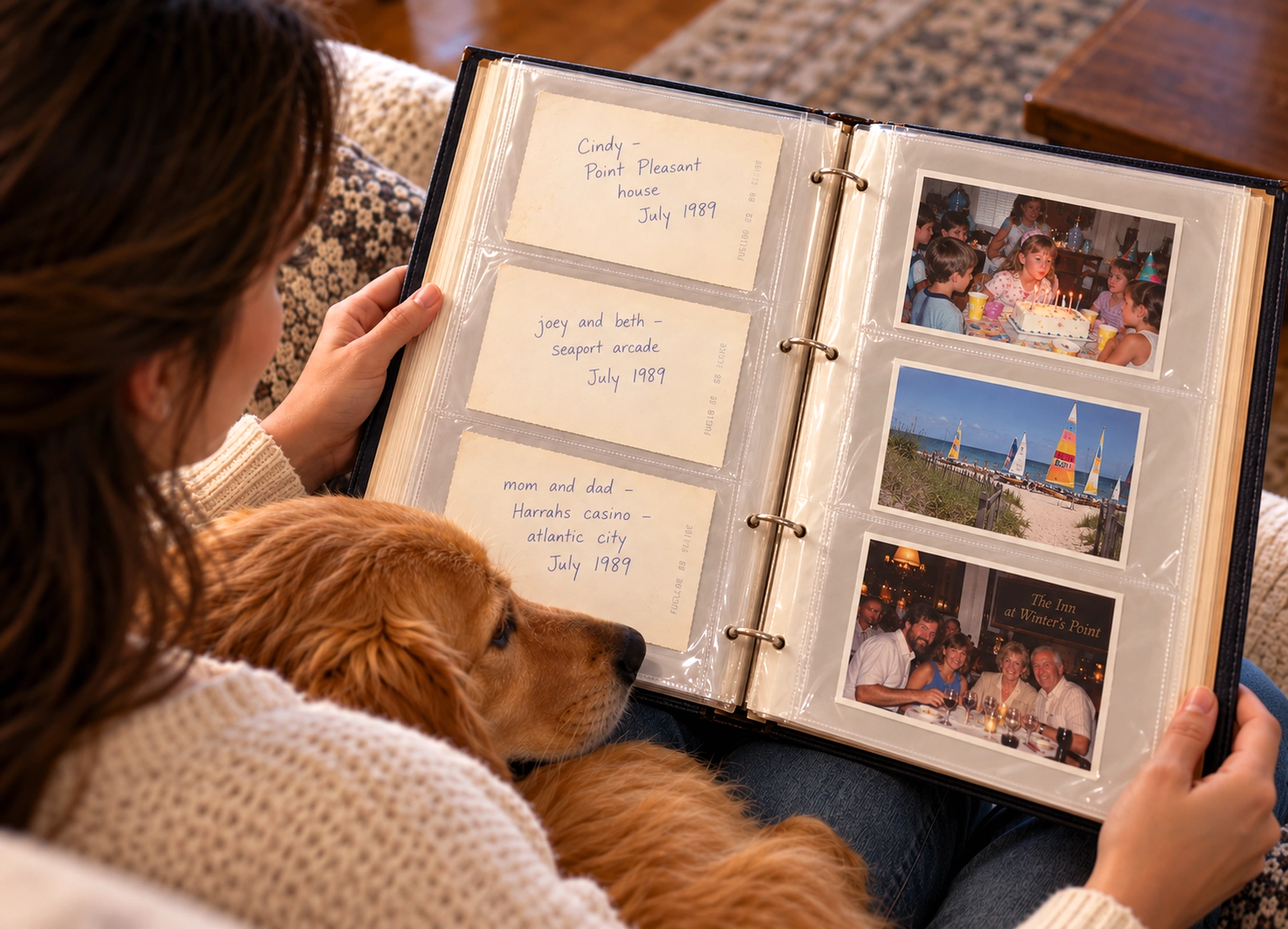
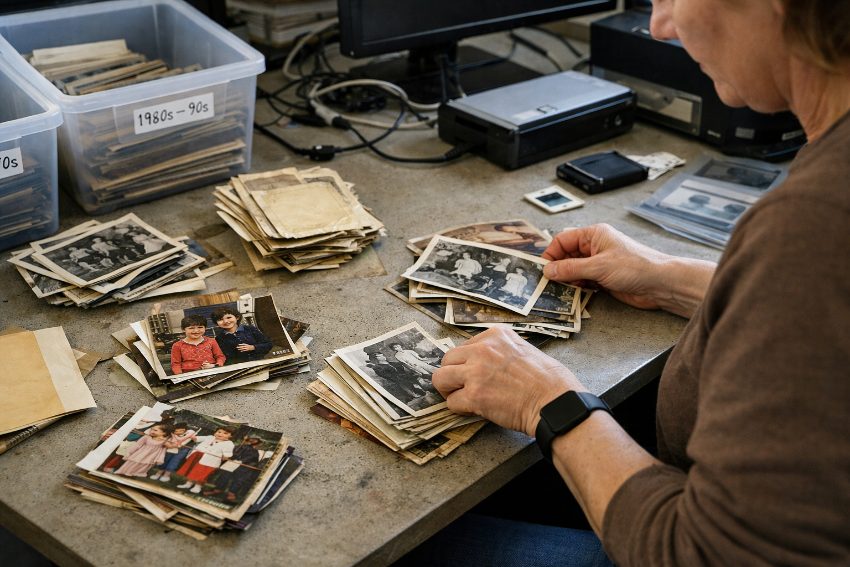
These are things that people tend to treasure, but struggle to store and preserve: old photographs, VHS tapes with scribbled notes, stacks of 8mm tapes encased in hand printed card, bulging envelopes full of black and white negatives, dusty slide carousls that have not been opened for years.
You are concerned about the future and this uncertainty may make your decision of what steps to take in the next few months or years difficult.
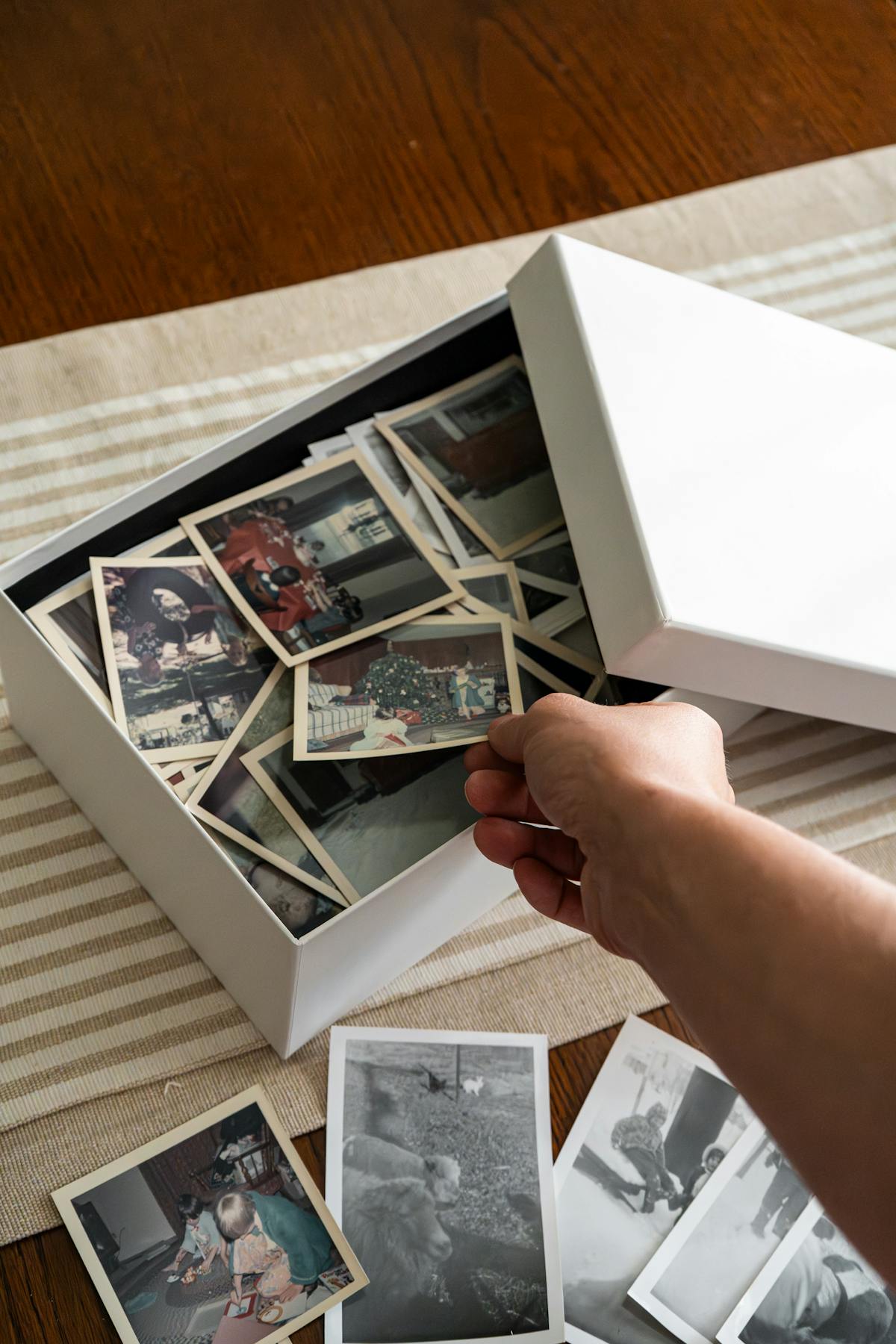
Inherited collections often contain decades of family history across multiple media formats, photographs, tapes, film reels, and slides.
So you’ve inherited a cupboard full of papers and photos from your ancestors. The internet is full of advice saying something like “just digitize it all and job done” but there are lots of complexities involved in managing the records of past generations. Before you start you’ll need to form some opinions about the condition of the items you have, how quickly you need to deal with them, the potential for future conservation and restoration, and most importantly who you can trust to turn your treasured family documents into clickbait and ad generated revenue.
You may discover that you have inherited collections of family history dating back decades, including photographs, vinyl records and music tapes, as well as 8mm film, video cassettes and slides.
Why Most People Get Stuck (And Why That Is Completely Rational)
So why do people get stuck, and why is it that getting stuck is completely rational for them?
When people inherit family treasures, they often sit untouched for months or years not because the person is lazy, but because it's hard to tackle the sentimental emotional task and they don't know where to start.
You are dealing with things that belonged to a loved one, or things that a family treasured but nobody knows what to do with. Is this old VHS tape worth playing back and what would you do with it if it did play back? Is a curled up photo safe in a shoe box for the next 10 years or should it be sent out for restoration? What is that and does it matter?
This one is going to have to wait. With real money on the line and somewhat ambiguous rules, you don't want to risk making a costly mistake.
The longer you put off working with an archive, the worse it can get. This is particularly true for archivists trying to work with decades old material. Sure, something of value may still be found amongst the dusty boxes, stacks of audio tapes, or the old computer media, but all media has a shelf life – some more so than others. While some media like magnetic tape doesn’t decay immediately, it can still suffer from a weakening signal strength that becomes irretrievable at a certain point. Film stock can also degrade to a point where it is extremely fragile to the touch. Photographs can even molder and decay to the point where high quality photo scanners are unable to recover them.
Don’t worry, this isn’t a disaster. But it is a good time for some learning and decision making.
Understanding What You Actually Have
There are many ways to restore black and white negatives, but first you have to know how to tackle them. Most formats deteriorate at different rates, and some need more specialized restoration techniques than others. Knowing how each format in your collection is deteriorating will help you tackle your collection in the best order to save time and money.
Photographs and Printed Photos
Of all the formats used to organize and display personal photographs, printed photographs are usually the hardiest. A photograph stored in a cool, dry space is likely to have a long life span. Photos in storage that have been in attics, garages, basements or other spaces where water damage may have occurred are often in worse shape and may display visible signs of deterioration, fading, browning, color change or other types of damage. In the case of stacks of prints stored in albums or boxes, the surfaces of the prints may even stick together.
The important thing to understand about photographs is that scanning them at proper resolution preserves everything that currently exists, but it does not undo damage that has already occurred. If a photo is cracked, faded, or water-stained, a good scan captures the photo as it is. Restoration is a separate process, one that requires judgment about what the image originally looked like and what should be corrected versus left alone.
When photograph’s are scanned to a high enough resolution all that currently exists in the image can be saved for restoration. What this means is that photographs that are badly cracked, faded, and water-stained can look beautiful after restoration. In contrast, versus image cleaning up for best viewing, there is a lot that can be done for neatening up images that aren’t suitable for complete restoration.
VHS, Hi8, MiniDV, and Other Videotapes
Many people are surprised by how much the tapes prove to contain. When people think of media degrading, they imagine tapes first, but they look the same even when half the signal is lost. Also, you can’t hold a tape up to a light source to verify its contents, unlike with photos.

VHS tapes look the same whether they play perfectly or have degraded beyond recovery. That is what makes them the highest-priority format to address.
You can’t judge a book by its cover with VHS and it gets worse from the outside in. So it makes sense to start with the worst ones first.
Tape digitizing is not a simple format conversion. The magnetic coating on tape physically deteriorates over time, the oxide layer sheds, the binder breaks down, and the signal weakens. Every year that passes means some percentage of what was recorded becomes harder or impossible to recover. This is why tapes are generally the highest-priority items in an inherited collection. Not because they are more valuable than photographs, but because they are losing information faster.
Most people assume that changing tape to digitizing is no big deal. In reality, the magnetic coating on tapes, over time, deteriorates, releasing tiny particles of oxide from the magnetic particles themselves. The binder can also break down, causing the tape to flake apart. Furthermore, the actual signal on the tapes will degrade with age, losing a small percentage of information every few years. Due to this fast-lost information, tapes are typically the highest priority for digitizing in collections of old media. Although photographs are just as important as the tapes, they are not losing as much information over time.
Of all your media probably your tapes are the most endangered. Especially your VHS tapes from the 80s and early 90s. This is because few still have the necessary gear to play back VHS tapes. Due to the mechanism and the age of the tapes
8mm, Super 8, and 16mm Film
Film reels are a mysterious and often forgotten part of heritage collections. When people inherit old film collections they may not know the format of the film or whether the old cans will still play the contents. But even if the film does play, what will they actually see?
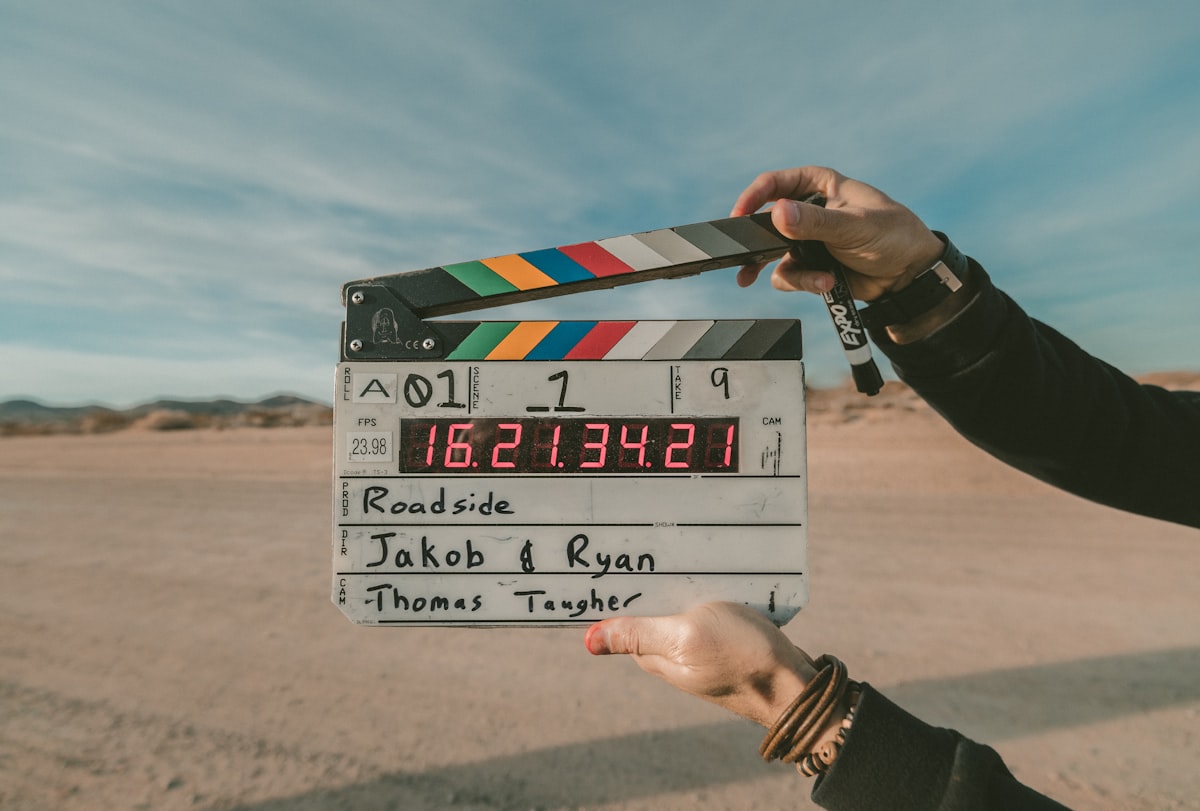
Film reels can last decades when stored properly, but most household storage falls short of what film needs to remain stable.
You pay to have your 4K film transferred over decades of technology, only to have it stored in a place as unstable as your home.
The good news is that film, when stored properly, can last a long time. The bad news is that "stored properly" is a high bar that most household storage does not meet. Film that has been exposed to heat and humidity can develop vinegar syndrome, a chemical breakdown you can sometimes smell before you see. Brittle, warped, or shrunken film requires careful handling by someone who understands the mechanics of film transfer, not just the equipment.
Film has the potential to last for decades or even centuries, but unless it is stored in a dedicated facility, the chances of it deteriorating are high. Home conditions are rarely ideal for film storage and the likelihood of tapes suffering from vinegar syndrome, a chemical change which causes the film to break down, is high. Even if the film survives, it can still go brown, become brittle, suffer from shrinkage, become warped or develop bubbles. All of these conditions require careful consideration when transferring film to a different medium.
Early specialist assessment is recommended if the reels smell of vinegar or the film appears rigid and will not uncoil.
Slides and Negatives
When organizing through years of photo collections, the bulk of your photos are likely to be in the form of slides or negative sleeves. Because these aren’t framed wall pictures, it is common for them to be thrown away but most high quality images are found between negative sleeves and in slide carousels. Often, they are the highest quality image available from your photos. Even further, many of your pictures only exist in these forms because the printed copies have decayed.
Scanning slides and negatives requires different equipment than scanning prints, and the results depend heavily on the quality of the scanning process. A flatbed scanner at home will capture something, but it will not capture what a professional-grade film scanner retrieves. If you are dealing with a large collection of slides, the difference between home scanning and professional scanning is not incremental, it is categorical.
What Matters Most, And What Can Wait
When working with slides and negatives as opposed to printed photographs, it requires different equipment to produce different results. While a flatbed scanner at home can easily pull an image from your slides and negatives, a dedicated film scanner will yield significantly different results, especially when processing large quantities of slides. What someone may think is an expenditure of money and increments of quality to increase photo resolution is actually the key to unlocking your entire slide collection.
Triage by Fragility, Not Sentimentality
Most timely items in our shop are those made from VHS or Videotapes. These items require the utmost care in their capture, which is why professional services monitor and calibrate every single capture to ensure that all recoverable frames are grabbed and included in the final transfer. Learn About Tape Digitizing
What Matters Most, And What Can Wait
As you work through your list of things you want to do to become a better developer, make sure to distinguish between things that need to be done urgently and things that simply need to be done. It is easy to mistake the two, and spend an inordinate amount of time focusing on a handful of things before coming into touch with real progress.
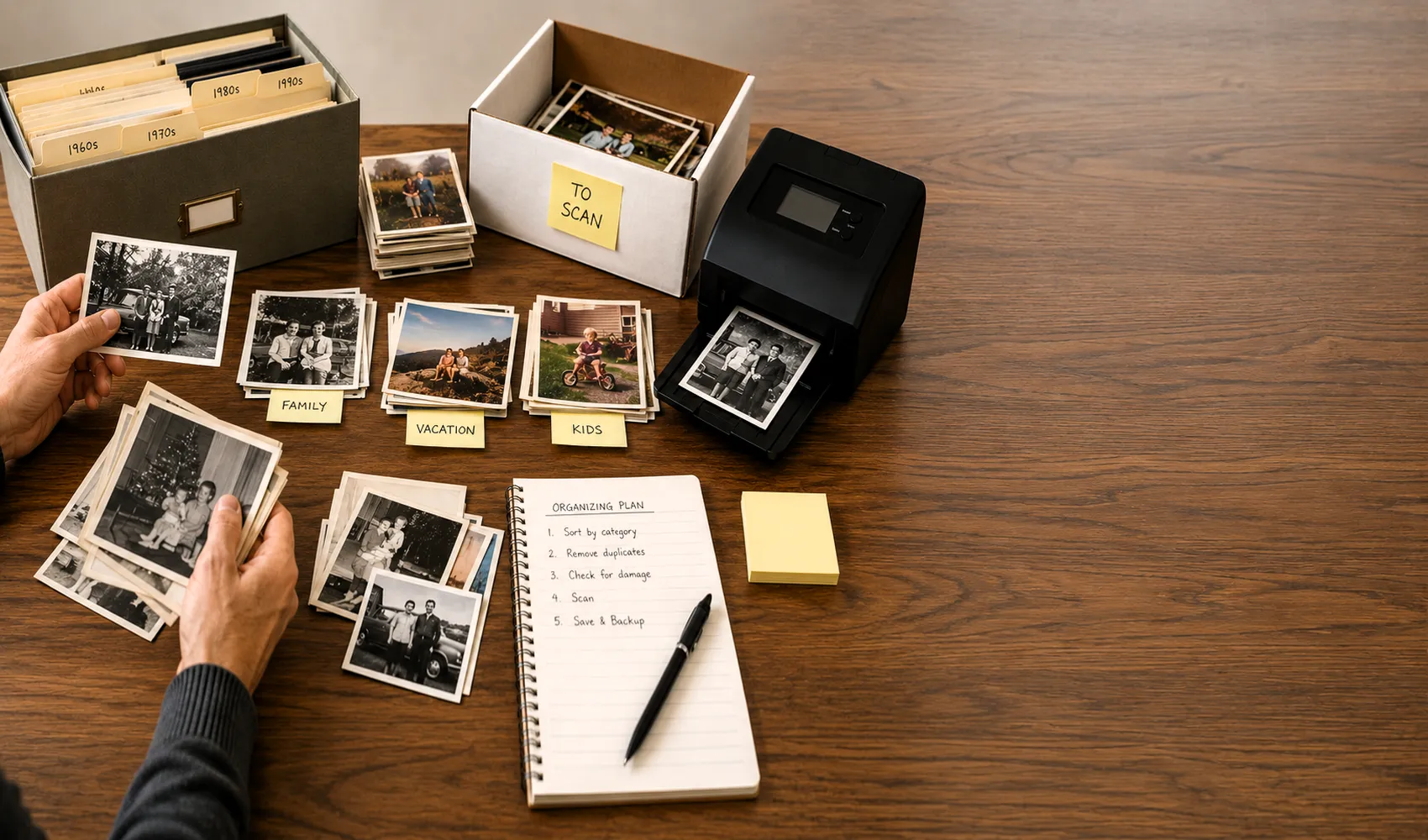
However, you should first start with items that are most meaningful to you such as your wedding video, a photo of a deceased family member that you have never seen before (such as a great grandparent), or your Christmas Reel from 1974. These items are important to you and you will want to make sure that they are properly archived and maintained.
First the most fragile items go in first. Then the photos. Next, the tapes and things that look obviously problematic before you ever touch the film. The nasty vinegar syndrome stains, mild mold, things like that. Then the water-damaged things. And please remember that things with high sentimental value decay quickly. That wedding tape that played beautifully today may not play in three years. A stable photograph is likely to still be scannable in a decade’s time.
It’s not a movie about ignoring important things once you start it. But it is a movie about not ignoring things that you can retrieve before it is over.
The "Good Enough for Now" Trap
While many people who have collections of physical media (such as VHS tapes and books) choose to archive them themselves (using things like VHS duplicators and budget book copying services), there’s a true “cost of free” (or low cost) to consider.
Even low-quality digitisation can still pick up an object from a poor quality source, and be of value. Replaying a broken or brittle tape will likely deteriorate it, further, but replaying the tape on a couple of consumer machines monitoring the output is likely to wear the remaining life out of the tape much more than having it professionally copied on calibrated machines.
Scanning photographs is safe for the original photograph as it results in a copy. But it is pointless to save photos of prints from a phone, as scanning a print is silly anyway. This results in the photo of a print having glare, angle distortion and ambient color shifts that shouldn’t be in the image. If you’re going to go to the effort of keeping a phone photo of a print why not just scan the print properly.
How to Find a Preservation Partner You Can Trust
The question is always the same: How do you find a good preservation partner? Preservation Texas frequently receives inquiries and assists property owners, donors, heirs, and representatives seeking the right partner to manage, maintain, renovate, or conserve historic structures. It is not an easy search; frequently, there are few resources or established organizations that
At this point the emotional cost of restoration starts to equal the financial cost. You may be asked to sign over originals that cannot be replaced for money. There should be an appropriate amount of trepidation at the risk you are about to take. It's a large sum of money, but it's dwarfed by the risk that you will be signing away something precious and irreplaceable.
What to Look For
First, find a good preservation studio. Ask them to explain the process in detail. They should be able to explain to you what happens to YOUR ORIGINALS from the time you send them in until the time they go back out again. Look at their work and decide if you like what you see. Get a estimate for the work and ask them to explain any and all hidden fees. Remember, you are paying for quality. Don't be afraid to ask questions and see how they respond. If you feel like you are being difficult for asking a question, then you're probably better off looking somewhere else.
Look for specificity. A company that explains what they do and why is a fundamentally different operation than one that hides behind convenience language and bulk pricing. The former has a process they believe in. The latter has a volume operation they are trying to fill.
Look for the specific language a candidate uses to describe a company they work for and its operating process. Is the candidate simply using generic language to describe a bulk pricing operation, or do they elaborate on the company's mission and the steps they take to carry it out and believe in?
What to Avoid
Be cautious of services that stress speed and low price above all else. Preservation is not such a field for the fast lowest bid. When a company advertises itself on the basis of price per tape or fast turnaround, the obvious question is where the company is making its economies, and the obvious answer is on the one thing that really matters most: attention.
Be equally cautious of services that make the process sound trivially simple. Digitizing old media is not trivially simple. Companies that present it that way are either underequipped or counting on the fact that most customers will not notice the difference between a careful transfer and a careless one until it is too late.
Be wary of vendors who make media transfer look easy. Digitizing your old media is not that easy. While some vendors may make it out to be, others will mislead you before you sign up. By the time you realize the deception, it will be too late.
What the Process Actually Looks Like
For your dime, you might expect more than simply paying to send your stuff and receiving a handful of files. You pay for the services of a professional preservation studio expecting more than that.
When transferring from tape formats, our studios review each tape for any visible signs of mold, damage or mechanical malfunction that could cause problems during playback or require special equipment for playback. Studio technicians monitor the playback and transfer process to ensure proper signal quality, accurate tracking and color. The end result of our mastering and transfer process is a high quality, bit-for-bit accurate digital file. A quality service will NOT create highly compressed low-resolution files that lose half the quality of the original tape.
For film, the process involves careful inspection, cleaning, and transfer through a system designed for the specific film gauge. The equipment matters, but so does the operator, someone who understands film stocks, exposure, and the particular ways different film types age.
For photographs, professional scanning means consistent resolution, color calibration, and handling that does not introduce new damage. For large collections, workflow engineering, the process of maintaining quality across hundreds or thousands of scans, matters as much as any single scan.
It was not a simple matter of throwing a bunch of tapes into a digital converter. Frames were inspected, materials removed from both sides and the footage then properly transferred gauge to gauge using high quality equipment. Each stock of film has its own characteristics, special needs for optimal exposure and decay over the years. The need for an experienced and knowledgeable operator cannot be overstated.
A preservation partner can also scan in photographs for you. Professional services can handle old photographs and scan them to a high standard, with consistent resolution and color calibration. As important as getting the initial scan right is designing a workflow that will allow you to maintain high quality standards when processing hundreds or even thousands of photographs.
All items are returned to you in full working order and in good condition after repair or service.
What Happens After Everything Is Digital
While many are under the impression that having your materials scanned means you get to sit back and have fun while someone else does all the work, there are actually more opportunities and challenges involved with having your materials turned digital.
Once digitized, inherited photos and videos can be shared, restored, and even printed as wall art, completing the journey from forgotten box to living memory.
A preservation partner can also digitize your collection of photos and videos, share them with loved ones, professionally restore them to great condition and beautifully display them as wall art – printed and framed to enhance your home.
Organization and Sharing
There's also the added benefit of easily reproducible digital files, which can be set up as backups and distributed to family members living in other states. So chances are that even a catastrophic flood or fire will only damage a small portion of your total collection, and you'll get to see the results of decades of media accumulating on your shelves. And let's not forget that you'll get to see and enjoy all of that media for yourself - that old Reel-To-Reel or Analog Cassettes can now be completely restored and enjoyed for generations to come.
Viewing the outtakes of archived digitized media provides a new experience of reliving one’s past. You get to see footage you never knew existed, view photographs you had never seen, and hear the voices of people you had forgotten. This is just one of the many reasons why preservation is important. It brings back to life an experience of the past that you had left in a closet as items in a box.
Restoration and Enhancement
Once a photograph is digitized, damage that seemed permanent becomes workable. Professional photo restoration can repair cracks, remove water stains, correct color shifts, and recover detail that time and storage degraded. The quality of the restoration depends on the skill of the person doing it, good restoration is invisible, preserving what was real while correcting what went wrong. Poor restoration introduces artifacts, over-smooths detail, or changes faces in ways that make them feel unfamiliar.
This is an area where the distinction between AI-automated tools and professional restoration is especially meaningful. Automated tools can handle simple fixes, but they do not understand what a face looked like, what a place meant, or where the line is between correction and fabrication. For photos that matter, and these do, or you would not be reading this, the judgment of a real person makes a difference.
Once a photo has been digitized it is usually irreparable no more, but badly irreparable. That means, even after it has been scanned for use in books, archives, albums, or slideshows for presentation or entertainment, photo restoration can still bring back a glowing, original looking image. Whether the photo shows cracks in a wood frame, water rings or spots, fading or unsaturated colors, or blurry or dim areas, restoration can return your old photo to a “good as new” condition. Great restoration is all but invisible, yet still reveals details hidden in the original image. Poor restoration, on the other hand, is all too visible and can look unnatural, overprocess the image, smooth out too much texture, or even change the faces of the people in the picture.
This is where AI-powered, photo restoration software hits a wall and human photo restoration specialists step in. Sure, such software is excellent for performing a quick fix on some images, but quickly fail when faced with images that require understanding of what a persons face looked like, what a location looked like, and exercising restraint and proper judgment between what is acceptable restoration and image manipulation. There is truly no substitute for human judgment and care in bringing out the best in your special photos.
Making It Physical Again
There is a particular satisfaction in taking a damaged, faded photograph that has been sitting in a box for decades, having it scanned, restored, and then printed as a piece of wall art that can live in your home. It is one of the few outcomes in this process where something genuinely transforms, where a neglected artifact becomes a visible, present part of daily life.
One of the outcomes of the photograph restoration process is that you can print and hang the final result as a piece of wall art. There’s something very rewarding about taking a yellowed, damaged, faded photograph from decades past, then scanning, restoring and finally printing it out as a piece of art to be displayed in your home.
For some, this is the most emotional part of the book. Turning a digital file into a physical object between the pages of another book is incredibly fulfilling. These printed pages are the presence of something that seemed to have vanished completely.
Skilled restoration artists can restore your old cracked, faded or water damaged photos back to how they originally looked. Our photo restoration artists can restore the actual appearance of your old photos, then correct for any of the deterioration that occurred over time. See Photo Restoration. Services also include Photo Retouching, Photo Editing and Digital Painting. See Digital Painting.
You Do Not Have to Figure This Out Alone
Life can be unpredictable. One minute you are in control, the next minute the ground can shift. Feeling lost and worried.
A trusted preservation partner can offer help and support.
Most people reading about this process are new to it. So they will be feeling slightly intimidated and worried that they will make some mistake that more experienced people can do easily. Perhaps more worrying for them is the question of what they will get from reading my posts, and whether it will be worth their money. These are the worries that will occur to most people.
An inherited media problem is not necessarily a technical problem, it is a trust problem. Trusting that the media has been handled seriously and correctly preserved for posterity and that it will be restored seriously and correctly. In the end the biggest challenge is to have enough trust in you to start. You won’t have all of the answers when you begin, but that’s okay.
Approach your treasures from the least sensitive side first. Start by understanding what you have, finding the right partner(s) in crime, and take it one step at a time.
This is a collection of stuff that made it to you. Which means something. Now you have to work to keep it from meaning nothing to those after you.

Ready to digitize it right the first time?
Bring your tapes, film, and photos to the team that treats every project as irreplaceable. All work is handled in-house in Boca Raton, never outsourced.