What Is Vinegar Syndrome on Film Reels? | Forever Studios
Vinegar syndrome is the irreversible chemical breakdown of acetate film. Learn what the smell means, how to identify it, and what to do to save your footage.
Contents
Many preservationists can identify the smell of vinegar syndrome at a distance. But for those who have to actually handle the decayed film, the smell can be overwhelming. Some describe it as vinegar-like, others as like acetone or nail polish remover. That smell is caused by the irreversible chemical decomposition of the acetate film base, producing acetic acid, a process called vinegar syndrome. It cannot be reversed, but it can be slowed. If your old Super 8 or 8mm film reels smell of vinegar, they have begun this process. The footage may still be intact. Whether you can recover it depends on how far along the deterioration is and how quickly you act.
Forever Studios is a professional photo and film preservation studio in South Florida that handles acetate film at every stage of deterioration, including reels that most mail-in services won't touch.
- Vinegar syndrome is autocatalytic acetate film degradation that releases acetic acid and cannot be chemically reversed once begun.
- Film stored at 70°F/40% RH has approximately 50-year useful life; storage at 55°F extends this to roughly 150 years.
- Early symptoms include vinegar smell and slight waviness; advanced stages show channeling, brittleness, and base shrinkage exceeding 10%.
- Cold dry storage below 50°F at 25–35% RH slows progression but digitization is the only permanent preservation method.
- A-D Strips® score 0–0.5 indicates no deterioration, 1.0–1.5 mild, 2.0+ severe degradation requiring specialist handling.
What Causes Vinegar Syndrome in Old Film Reels?
Vinegar syndrome is the common name for acetate film base degradation. Cellulose acetate was used to manufacture 8mm, Super 8, and 16mm home movie film from roughly the 1950s through the 1990s. As the film base breaks down, it releases acetic acid into the air, which is the source of the vinegar smell.
The degradation is autocatalytic, meaning the acetic acid released by the film accelerates further breakdown. It gets worse at an increasing rate as time goes on. According to the National Film Preservation Foundation, once vinegar syndrome begins it cannot be chemically reversed. The film can only be stabilized by controlling the environment it is stored in.
Warmth and humidity accelerate this process significantly. The Image Permanence Institute at RIT, which developed the A-D Strips® test for measuring acetate deterioration, found that film stored at 70°F and 40% relative humidity has an estimated useful life of about 50 years before onset. Storage at a cooler 55°F extends this estimate to approximately 150 years. Most family film collections have spent decades in attics, garages, or storage units, conditions that sit at the worst end of that range.
How Can You Tell If Film Has Vinegar Syndrome?
The Smell
The earliest sign is smell. Acetate film in good condition has a faint, neutral chemical odor. Film in early vinegar syndrome smells distinctly sour, like vinegar, acetic acid, or nail polish remover. Some people confuse it with musty or old film smell, but vinegar syndrome has a sharper, more chemical quality.

The unmistakable vinegar smell is usually the first warning sign that acetate film has begun to deteriorate.
Physical Signs to Look For
Physical signs to look for: waviness or bubbling at the edges of the film strip, where the base shrinks unevenly causing the film to curl or buckle; channeling, shallow but often wide grooves that form across the width of the film; white powder or crystalline deposits on the reel or inside the canister from acetic acid residue; and brittleness, where in advanced stages the film cracks or snaps rather than flexing.
Professional Assessment: A-D Strips
The A-D Strips® system from the Image Permanence Institute uses color-coded indicator strips to measure the level of acetate deterioration. A score of 0–0.5 indicates no deterioration, 1.0–1.5 is mild, and 2.0 and above signals severe degradation. This is one of the assessments made before any transfer begins.
Forever Studios · Boca Raton, FL
Film Digitizing Service
8mm, Super 8, and 16mm reels transferred frame-by-frame to digital.
LEARN MORE →Can You Reverse or Stop Vinegar Syndrome?
No. Once acetate film has begun to degrade, the chemical reaction cannot be reversed. What can be done is slowing it down significantly through proper storage, and, most importantly, digitizing the film before the footage is lost. This is the same principle behind the technique Harvard researchers use to rescue deteriorating video: control the environment to buy time, then capture the content before it's gone.
Cold, dry storage below 50°F at 25–35% relative humidity slows degradation far more than room-temperature storage. The National Archives recommends cold, dark, dry storage for all film-based materials as the primary conservation method. However, most home environments cannot realistically achieve or maintain archival cold storage, and the average attic or closet actively accelerates the process.
The only permanent solution is transferring the film to a digital format while the footage is still readable. A reel that smells of vinegar today can still be played and captured, but that window closes as deterioration advances and the film becomes too shrunken or brittle to run safely through a transport mechanism.
What Happens to Film Footage as Vinegar Syndrome Gets Worse?
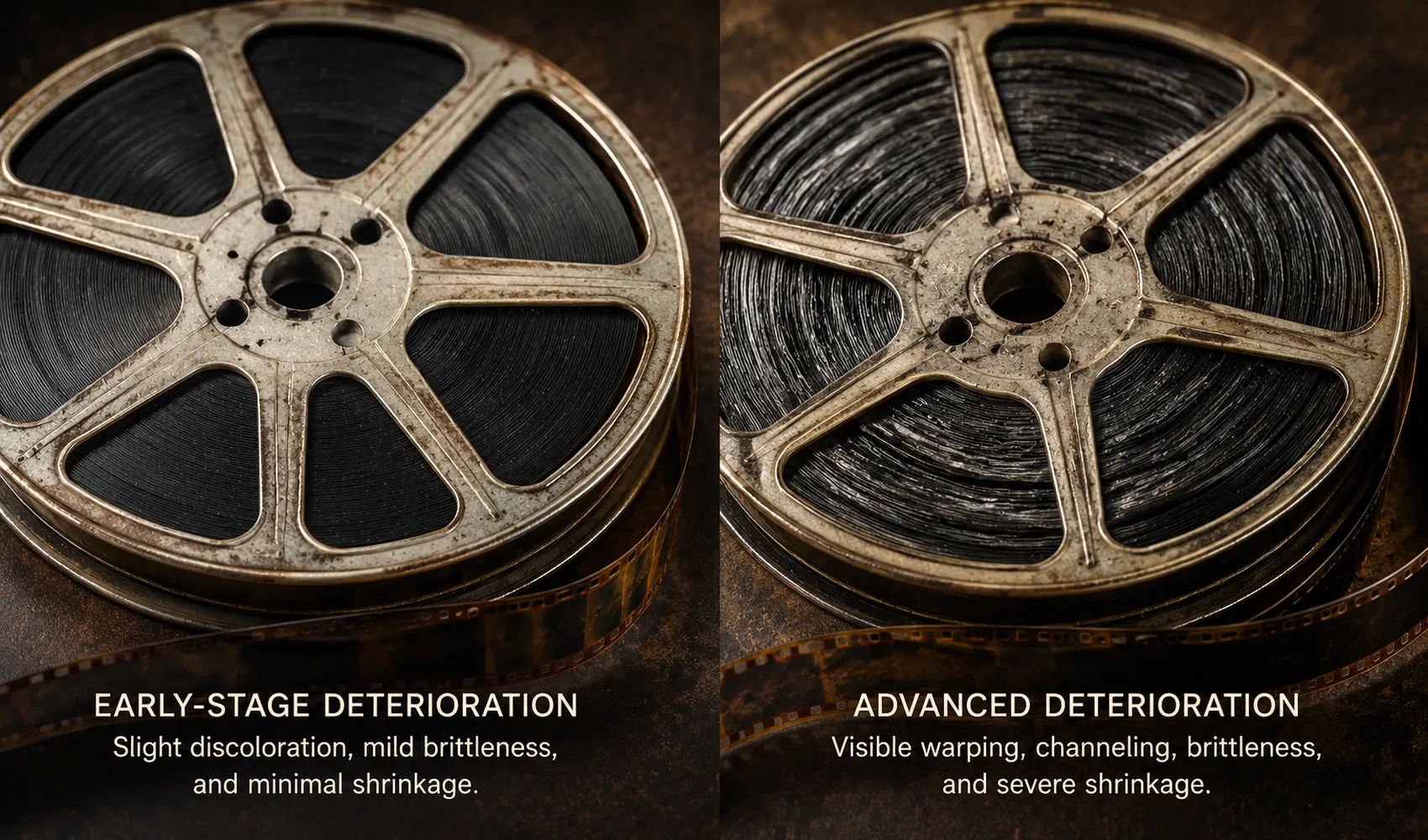
A reel in early-stage deterioration (left) compared to one showing visible warping and channeling (right).
Vinegar syndrome progresses in stages. In early stages the smell is the primary symptom and the footage is typically fully intact and plays back correctly. As the syndrome worsens, the plastic base begins to shrink, in severe cases to more than 10% of the original film width, which means a strip engineered for specific playback equipment becomes the wrong size to run through it.
That shrinkage causes two compounding problems. The first is that it pulls the base away from the gelatin emulsion layer that holds the image, causing channeling, buckling, and in severe cases delamination of the entire strip. The second is that the film becomes increasingly brittle, in advanced stages a print can break under very slight pressure. This is why physical deterioration in old media must be assessed before any playback attempt.
At that point, recovery requires specialized frame-by-frame scanning equipment, where the film is not pulled under tension. This is more expensive and time-consuming than a standard transfer, and not all studios are equipped for it. The research is consistent: a reel that smells faintly of vinegar today is recoverable. A reel that has channeled and buckled significantly may need specialist intervention. A reel that has become brittle may not be playable at all.
Forever Studios · Boca Raton, FL
Film Digitizing Service
8mm, Super 8, and 16mm reels transferred frame-by-frame to digital.
LEARN MORE →How Much Time Do You Have Before Film Becomes Unplayable?
There is no universal answer, the timeline depends entirely on how the film has been stored since it was shot. Film stored for 40 years in a climate-controlled interior may still be in early-stage deterioration. Film stored for the same 40 years in a Florida garage may be approaching advanced stages.
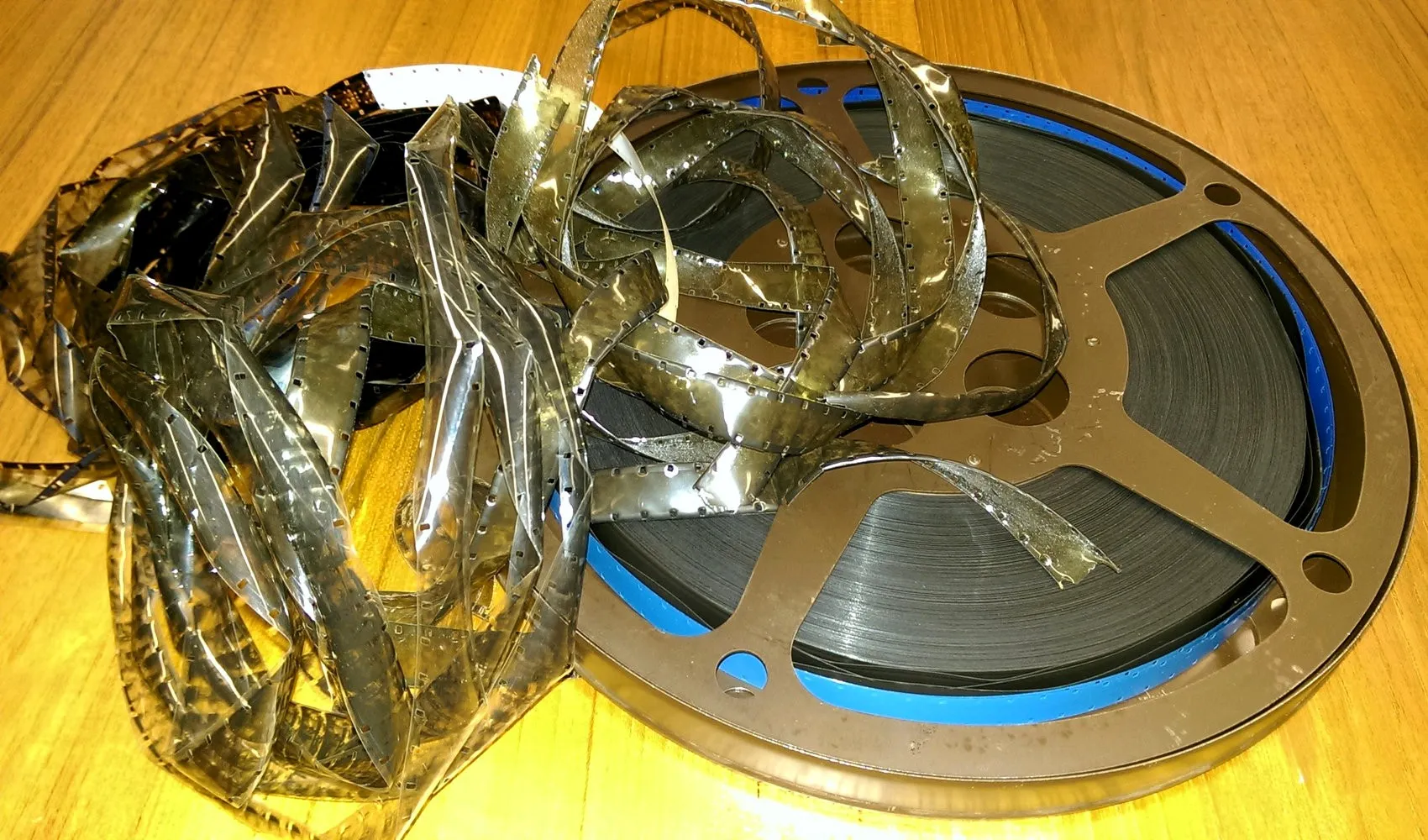
Once the film base curls and warps this severely, conventional projection becomes impossible and recovery options narrow.
The Image Permanence Institute's research indicates the degradation window is temperature-dependent and declines roughly exponentially as storage temperature rises. As a rough guide, every 10°F drop in storage temperature approximately doubles the useful life of the film. Moving film from a warm location to a cool, stable interior, not professional archival cold storage, just a temperature-stable room, can meaningfully extend the window while you arrange a proper media transfer.
Greg Evangelista, Marketing Director at Forever Studios, describes the assessment this way: "By the time we can smell the film, it's already in the process. We're evaluating where it sits in the progression, whether it's still straightforward to transfer, or whether it needs more careful handling. The earlier we see it, the more we can do."
The practical reality for most families is that the film has been in suboptimal storage for years or decades before it surfaces. The right response isn't to wait for a better moment, it's to act now while the footage is still recoverable. If you've recently inherited old tapes and film reels, this applies especially to any reels that have been in storage without climate control.
""
Greg E., Preservation Specialist, Forever Studios
★★★★★
"Forever Studios digitized 26 three inch 8 mm reels that my in-laws took in the mid/late 1960's. These reels had been moved across states and stored in the basement for the last 45 years. The results of the digitized video were great considering the age of the reels and the technology of the 1960s. With the Order Tracker and emails from Forever Studios, I knew where my project was in the process. I will be using Forever Studios to digitize my families 8mm reels from the early 1970's along with some VHS tapes."
Amy, verified customer review
What Should You Do If Your Film Smells Like Vinegar?

Proper archival handling begins with separation and cool, stable storage, before any transfer is attempted.
If you've opened a box of film and detected a vinegar smell, these are the immediate steps that matter.
Separate the Affected Reels From Other Media
Acetic acid vapor accelerates deterioration in nearby film and photographs. Store the affected reels away from everything else, and ventilate the area if possible, vapor buildup inside a sealed canister drives the autocatalytic reaction further.
Move the Film to a Cool, Stable Environment
A temperature-controlled interior space is better than an attic or garage. Do not put film in a household freezer without slowly acclimatizing it first, placing film directly in a cold freezer causes condensation that can worsen the damage.
Do Not Attempt to Play the Reels Yourself
Running degraded film through a home projector under tension risks breaking it at the most fragile points. Playback of deteriorating film should be done by professionals on equipment suited to handling brittle material.
Get Them Transferred
This is the only action that permanently protects the footage. A professional film transfer captures what's on the reel and produces a digital file that does not degrade. The original film will continue to deteriorate even after transfer, but the footage is preserved. For 16mm film reels, the same principles apply. Forever Studios handles Super 8, 8mm, and 16mm film at all stages of deterioration, including reels with significant vinegar syndrome. Our film transfer service is equipped for frame-by-frame capture when the condition requires it. Assessing your reels costs nothing, the sooner we know what you have, the more options there are. Even films have an expiration date. You control how long you let them expi footage. A professional film transfer captures what's on the reel and produces a digital file that does not degrade. The original film will continue to deteriorate even after transfer, but the footage is preserved. For 16mm film reels, the same principles apply.
Forever Studios handles Super 8, 8mm, and 16mm film at all stages of deterioration, including reels with significant vinegar syndrome. Our film transfer service is equipped for frame-by-frame capture when the condition requires it. Assessing your reels costs nothing, the sooner we know what you have, the more options there are.
Even films have an expiration date. You control how long you let them expire.
How long does film last once vinegar syndrome begins?+
The timeline varies dramatically based on storage conditions. Film stored at 70°F and 40% humidity has an estimated useful life of about 50 years before vinegar syndrome onset; at 55°F this extends to approximately 150 years. Once deterioration begins, progression speed depends on temperature, every 10°F drop in storage temperature roughly doubles remaining useful life. Film in early-stage vinegar syndrome (smell only, minimal physical damage) may remain transferable for years if moved to cool storage. Advanced-stage film with channeling and brittleness may need specialist intervention immediately.
Can I stop vinegar syndrome once it has started?+
No, vinegar syndrome cannot be chemically reversed once the acetate film base begins releasing acetic acid. The degradation is autocatalytic, meaning the acid accelerates further breakdown. Cold, dry storage below 50°F at 25–35% relative humidity slows the progression significantly compared to room temperature, but cannot halt it. The National Archives and Image Permanence Institute both confirm that controlling storage environment buys time, but digitizing the film is the only way to permanently preserve footage before deterioration makes playback impossible.

Ready to digitize it right the first time?
Bring your tapes, film, and photos to the team that treats every project as irreplaceable. All work is handled in-house in Boca Raton, never outsourced.