The Deadline to Save Your VHS Tapes Already Passed. Here's What That Means.
Magnetic tape, vanishing VCRs, and the closing window for family videos
Contents
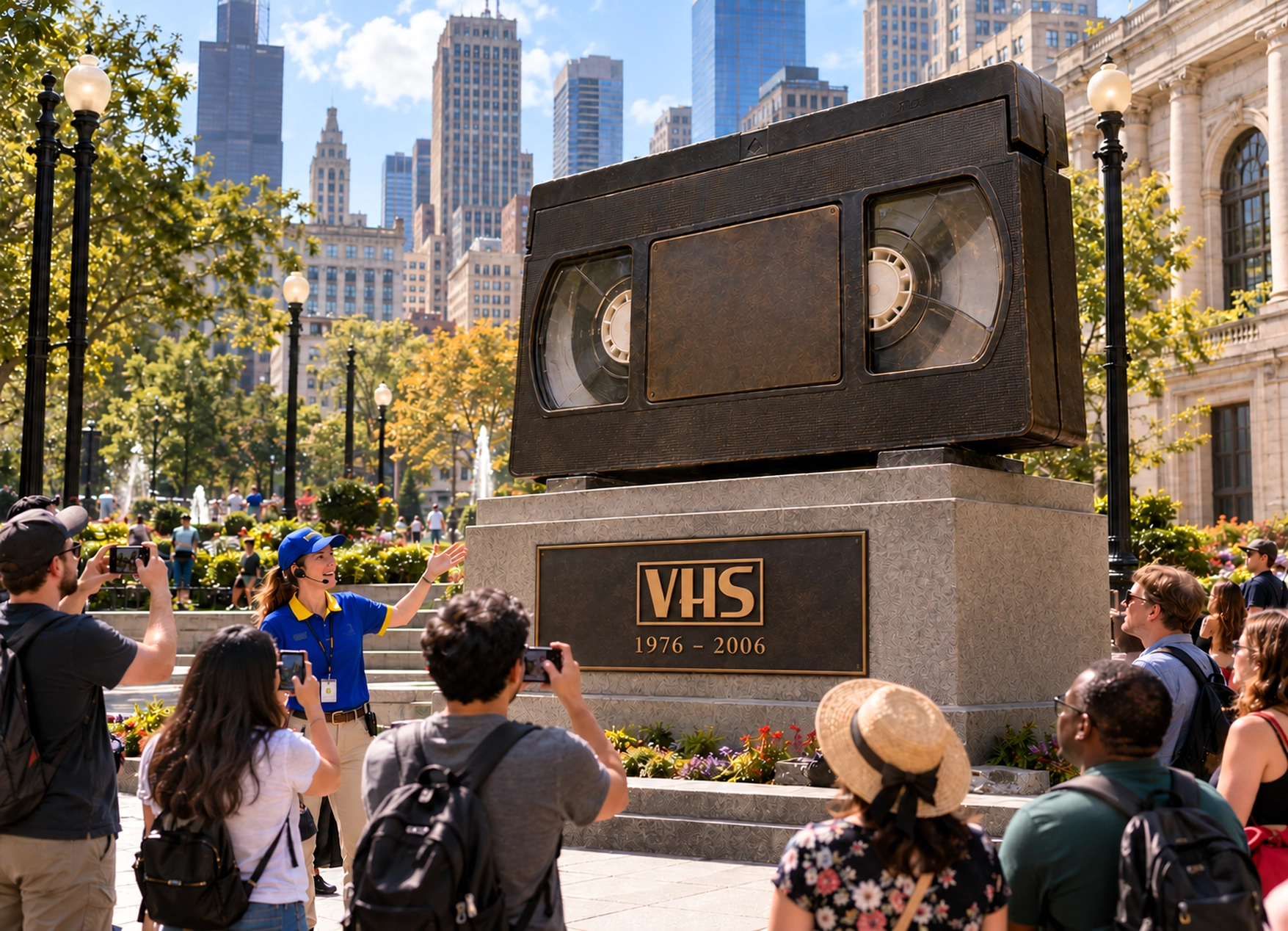
Most consumer VHS tapes have an expected life span of 15 to 25 years. And it is within this time frame that most home movies were recorded, between 1985 and 2005. Archivists recognized long ago that magnetic tape recorded at home would be at risk in a relatively short period of time, for the reasons of the deterioration of the tape itself, the obsolescence of the machines to play it, and the loss of human expertise to operate the machines. In 2015 the National Film and Sound Archive of Australia published a report, Deadline 2025: Collections at Risk. The report, written with input from archives around the world, spells out the many problems faced by collections of magnetic tape. It predicted that without significant investment in digitization, most would be lost by 2025, and estimated that only about 30 percent of all magnetic tape holdings would be saved in time. That deadline has now passed.
There is no fixed shelf life, and all tapes deteriorate at different rates. As tapes deteriorate they can often still be salvaged, and so the biggest challenge is not that the tapes cannot be saved but that they are being lost as they deteriorate. There are three main challenges: the deterioration of the tapes, the obsolescence of the players, and the loss of skills. This article walks through each one, and what to do about the tapes in your own closet.
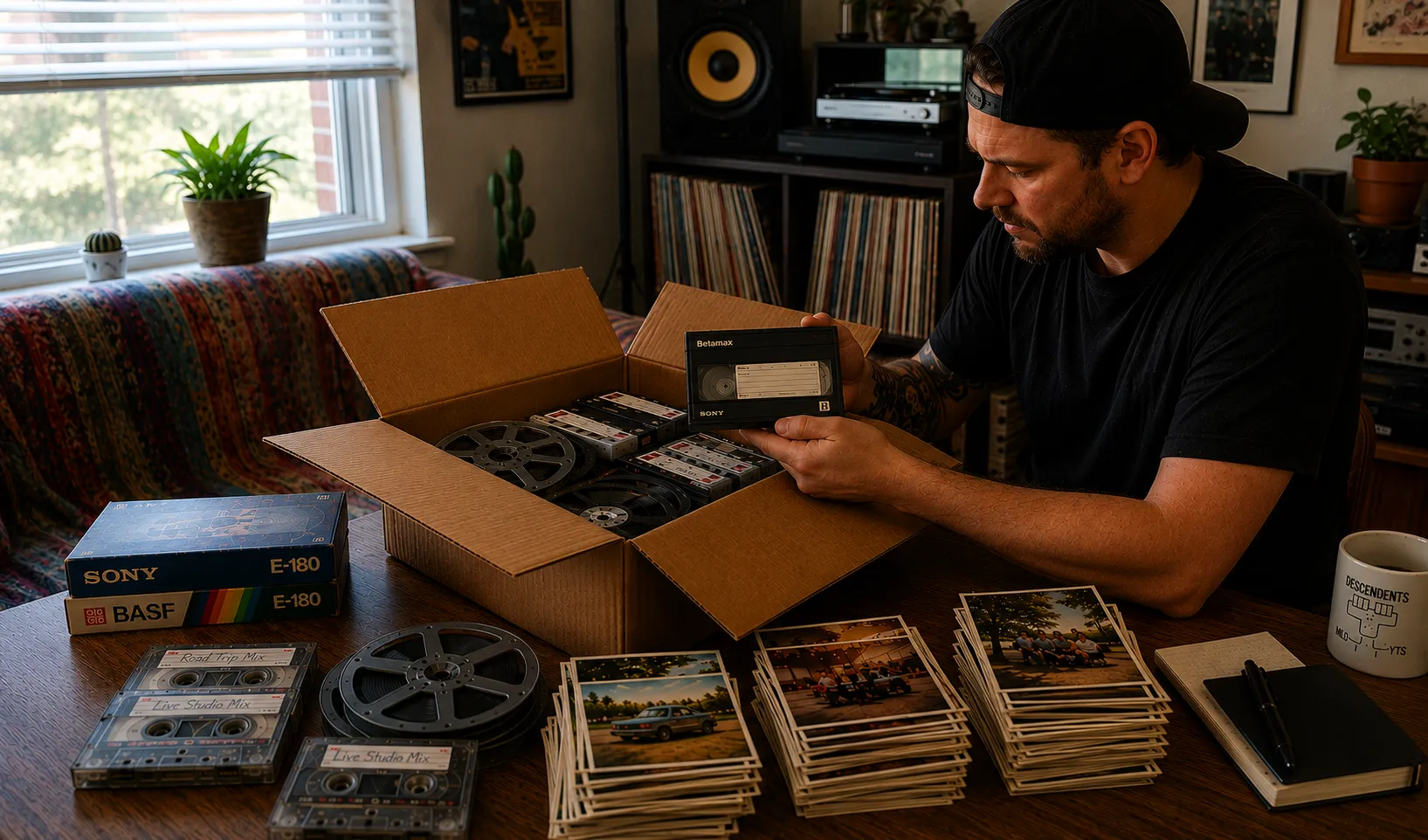
A single box of family media often holds three or four different formats, each aging on its own clock.
How long do VHS tapes actually last?
On average a VHS tape has a life span of about 15 to 25 years. AARP reports that magnetic tape, the base material of most video tapes, starts to lose signal after about 10 to 25 years depending on the amount of magnetic charge stored in the tape particles. Over time the color in the video image may fade. The image itself may become cloudy with static or visual noise. The audio track may decay into loud hissing. In extreme cases there may be horizontal lines that randomly drop out of the video image.
Magnetic tape also needs to be stored properly to ensure it lasts a long time. All magnetic media are sensitive to temperature and humidity, so storing your media in the lowest, coolest part of your home is best. A garage, attic, or storage unit is the worst place a tape can live. If you live in South Florida, sustained heat and humidity are the two conditions tape tolerates worst, so the coolest, driest part of your home is where your media belongs.
The recording date matters more than the format. If someone recorded a birthday party in 1992 on a VHS tape, that tape is now 34 years old. It has been losing signal for at least a decade, even by the optimistic end of the lifespan range.
Why does magnetic tape degrade even when it just sits in a box?
A VHS tape is made of a strip of polyester film which is coated with magnetic particles held together by a polyurethane binder. Each recorded event on the tape is a series of magnetic charges in the particles on the tape. Three different chemical processes can cause the recording to deteriorate while the cassette sits in its box. Tape can deteriorate before it is ever played.
First, the magnetic information on the tape begins to deteriorate as the magnetic charge in the particles weakens. This type of deterioration is typically irreversible and affects the signal strength of the recording. The signal strength of the recorded information on a VHS tape can decrease by as much as 10 to 20 percent every 10 to 25 years.
The binder on magnetic tape is also very sensitive to moisture in the air. In time, the binder can undergo a chemical change called hydrolysis. As the binder absorbs moisture from the air it can become gummy and begin to detach from the polyester base of the tape. This type of deterioration is known to archivists as sticky shed syndrome. Sticky shed can cause a tape to squeal during playback, gum up the VCR's heads, or be further damaged by playback itself. The condition is currently being studied by the Library of Congress's Preservation Research and Testing Division.
Thirdly, mold. Particularly in humid storage environments, mold can develop on magnetic tape and appear as visible white or gray growth along the edge of the tape pack. As mold eats into the binder of the tape it can spread to other tapes that are stored next to the affected tape.
VHS to Digital Transfer
We transfer VHS, VHS-C, Hi8, MiniDV, and Betamax tapes to digital files on professional decks with time base correction, including fragile tapes that need cleaning or repair first.
GET STARTEDWhich tape and film formats are most at risk?
In assessing the risk for the various formats, it would be best to first note which format is the most vulnerable and therefore need to be restored first. For the above stated consumer formats, VHS would fall in the middle; being more fragile than the above stated commercial video formats but less of a problem. However, for these types of cameras, the actual video tape formats would be the most vulnerable. As stated above, the thin tapes are typically stored in a camera bag or loose closet rather than in protective cases. The chances of shed tape, magnet static, or even other types of degradation are greatly increased for these types of tapes. Betamax, 8mm, and Super 8 formats have their own set of unique problems in that there are fewer machines that are equipped with the video heads of the type of VCRs that would play these formats. For well stored and apparently good quality tapes of these formats, even after a short period of time, these could also quickly deteriorate.
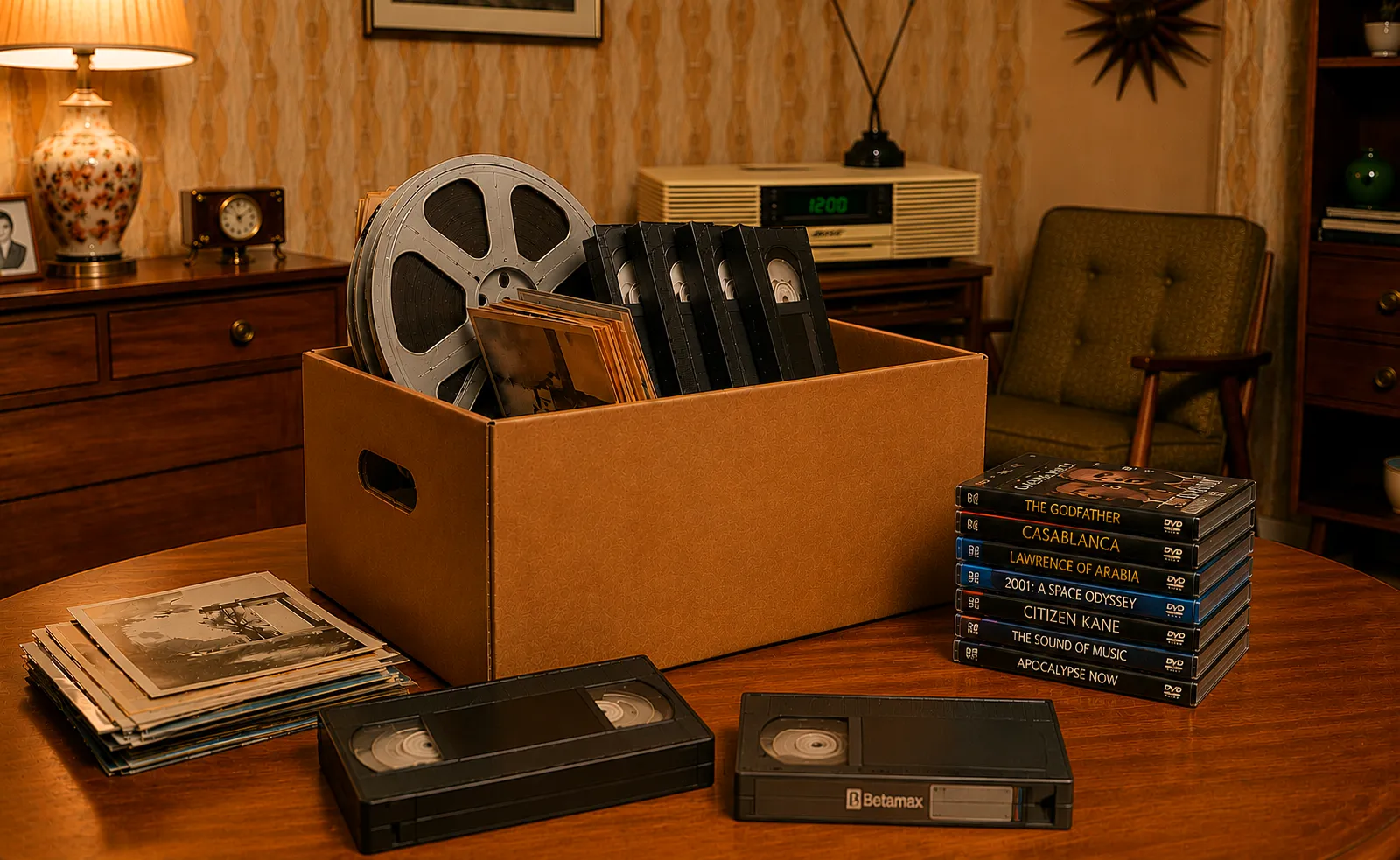
Most closets hold several formats at once, and the smaller camcorder tapes are usually the ones with the fewest surviving players.
VHS and other formats as VHS are in the middle of the range of fragility. The least quality will be lost when digitizing VHS tapes. The VHS tapes have a horizontal resolution of around 240 lines, which in general are recorded in standard definition (SD). In the digitizing process as described above the quality of the original recording will be maintained in the best possible way. The quality of the digitized files will not be up-scaled to 4K or any other high definition format. The other camcorder formats as Hi8 and MiniDV have a higher quality (up to 500 lines for the MiniDV) and therefore more detail will be lost when the tapes deteriorate. The film reels, 8mm and Super 8, are even more fragile. They are actually photographic film. These tapes do not have a magnetic signal, which deteriorates over time. The biggest problem with these reels is that they can shrink, become brittle and deteriorate through chemical changes (vinegar syndrome) when stored in a warm place for a long time. These formats need to be scanned frame by frame with specialized equipment.
| Format | Typical lifespan | Main risk | Can you still play it? |
|---|---|---|---|
| VHS | 15 to 25 years | Signal loss, mold, sticky shed | VCRs out of production since 2016; still findable |
| VHS-C / compact camcorder | 10 to 20 years | Thinner tape, often stored loose | Needs an adapter plus a working VCR |
| Betamax | 15 to 25 years | Same decay as VHS | Players are rare and hard to source |
| Hi8 / Video8 | 10 to 20 years | Higher resolution, more to lose | Camcorder-specific decks, increasingly scarce |
| MiniDV | 10 to 20 years | Digital dropouts as tape ages | MiniDV decks and cameras now uncommon |
| 8mm & Super 8 film | Decades if cool and dry | Shrinkage, brittleness, vinegar syndrome | Not tape; needs frame-by-frame scanning |
| Audio cassette | 20 to 30 years | Binder breakdown, sticky shed on some stocks | Quality decks out of production |
First, prioritize those camcorder tapes, particularly those formats for which there are no longer machines available to play back the tapes (and thus to transfer them to digital). Then, prioritize your VHS tapes. Next, turn your attention to your film reels, particularly those that are 8mm and Super 8 film, and have them professionally transferred by a service or lab that has the equipment necessary to play back your film and to digitize (or to digitize, frame by frame) your film.
"The tapes we worry about most are usually the little camcorder cassettes, not the big VHS ones," says Greg Evangelista, marketing director at Forever Studios. "People assume VHS is the fragile format, but it is the Hi8 and MiniDV tapes that are harder to save, mostly because almost nobody still has a working deck to play them."
What is Deadline 2025, and why did archivists set it?
Deadline 2025: Collections at Risk was a report published in 2015 by the National Film and Sound Archive of Australia. The report identifies three issues with magnetic tape: the tapes themselves, the equipment required to play back the tapes, and the people required to use that equipment.
The report concludes that the greatest threat to recorded audiovisual material is the prediction that less than 30 percent of magnetic tape collections will be saved through transfer to digital formats by the time the deadline passes. This conclusion was based on an analysis of investment in digitization at the time, projected forward. The report also prompted national institutions to launch digitization pushes of their own.
This estimate is not a prediction for any one archive. Rather, it is based on a survey of collections at risk from around the world and is intended to serve as a basis for action by collection holders everywhere. While the report was written by the National Film and Sound Archive of Australia, the crisis facing magnetic tape collections is a global one. The deadline was never written on the tape itself. But it is worth sitting with the fact that the institutions whose entire job is preserving recorded history looked at consumer tape formats and concluded that most of what was not transferred by 2025 would never be transferred.
Is the bigger problem the tapes or the machines?
As for the equipment, working VCRs have become a rare thing. In July 2016, Funai Electric, the last remaining manufacturer of VCRs, ceased production of the format. At the height of the market for video recorders, Funai produced 15 million per year. In its last full year, however, the company managed to sell fewer than one million. One reason for stopping was the lack of suppliers for necessary parts. As a result, all well functioning VCRs today are at least 10 years old and for the most part much older. Since no new parts are being made for these recorders, the number of fully functioning devices is dwindling every year. For this reason, professional archives are increasingly competing for well preserved playback devices.
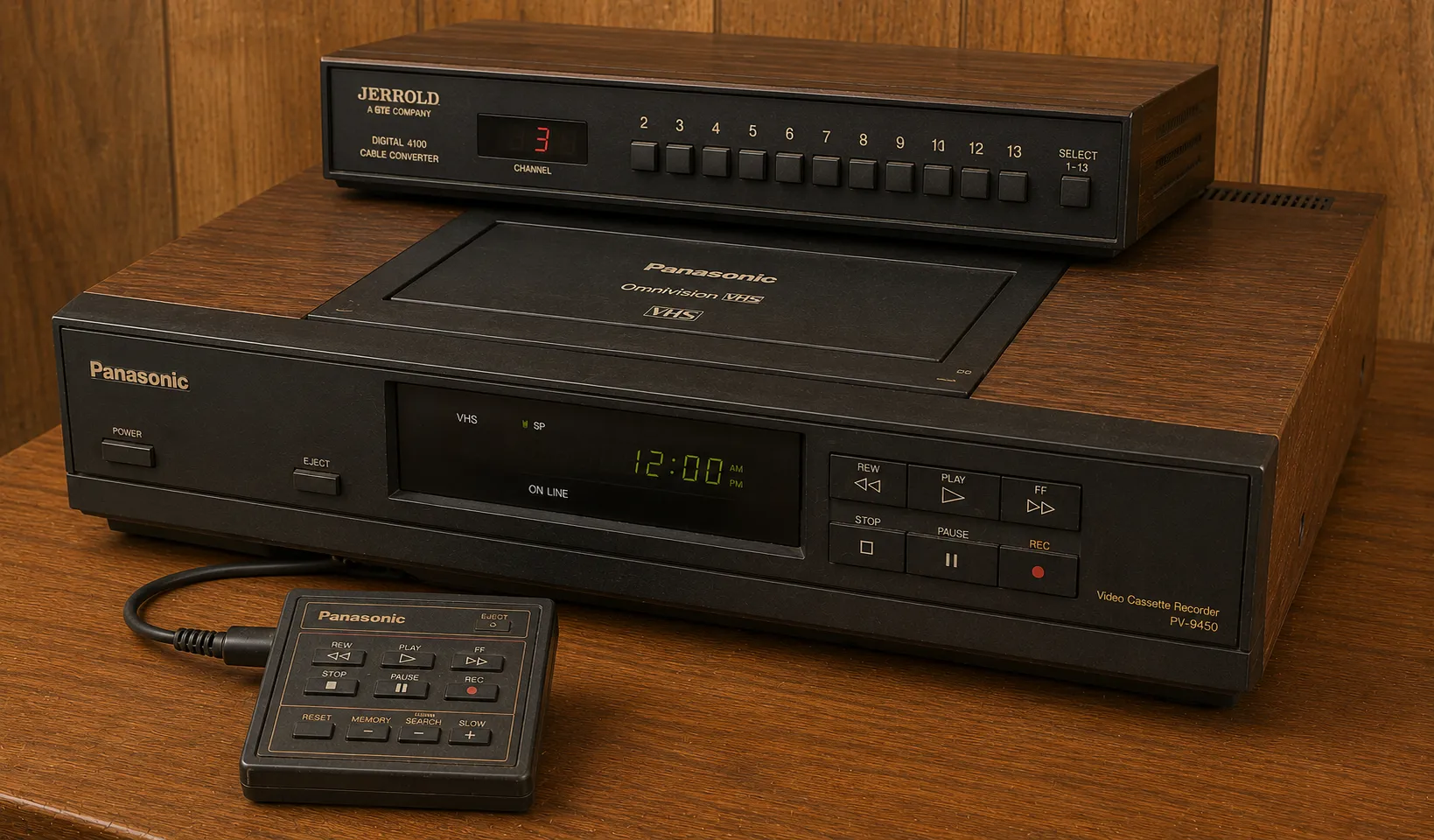
No new VCRs have been manufactured since 2016, and the supply of working machines shrinks every year.
The smaller camcorder formats are in worse shape. Every format of the past decades (Hi8, Video8, MiniDV, Betamax) requires its own playback device, and the production numbers of several of these formats were low to begin with.
Expertise is fading too. As the people who serviced equipment in broadcast environments retire, there will be no one left to service these same formats in archives and home collections. Most problems with tape are mechanical and not amenable to reading a manual. Even a careful person with a thrift store VCR can very easily destroy a tape. And it's not because they are being careless. They're just not familiar with the sorts of problems that can occur with tape. Knowing when not to press play is most of the job.
What are the signs a tape is already failing?
It is possible to tell whether a tape is in trouble without actually playing it. In many marginal cases you should not attempt to play the tape at all. Warning signs include:
- A squealing or screeching sound during playback, the classic symptom of sticky shed syndrome
- White, gray or powdery growth along the edge of the tape pack (mold)
- Wrinkles, creases or a wavy edge on the surface of the tape
- A tape pack that looks loose, stepped or unevenly wound when viewed through the cassette window
- A video track that rolls or jitters on playback, color that bleeds, heavy static, or audio that slowly gets out of sync with the video
Some of these defects can be fixed by a professional, who can then transfer the tape. Others make the tape extremely fragile, and if you play them on a VCR at home the tape could be ruined for good. A tape that is shedding should not be played on a VCR under any circumstances, as the flaking coating can foul the playback heads and strip the recording off the base film.
Full Collection Media Digitizing
Tapes, film reels, photos, slides, and audio in one project. We inventory, digitize, and return everything with organized digital files you can share with the whole family.
GET STARTEDCan a degraded tape still be recovered?
Usually, yes. Each of the problems of tape deterioration has been faced by others and a solution found. No problem with tape deterioration is more notorious than sticky shed syndrome. Through controlled low-temperature dehydration, known informally as tape baking, tapes suffering from this affliction can be returned to a playable state. Research at the Library of Congress has documented the physical change that takes place in the binder of tapes baked at 54 degrees Celsius, which is why the treatment temporarily restores playability. A baked tape typically has a window of weeks in which it can be safely played and transferred.
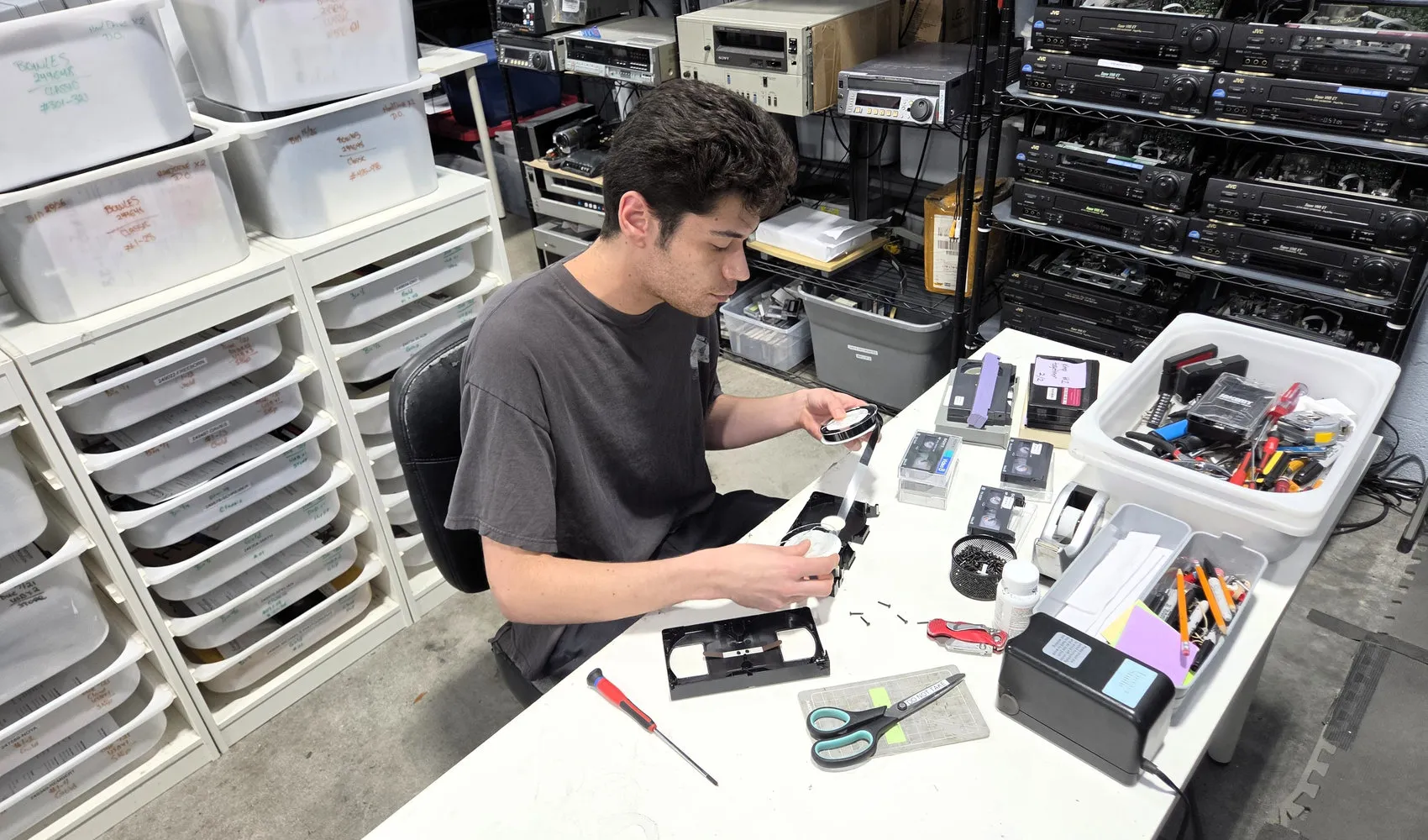
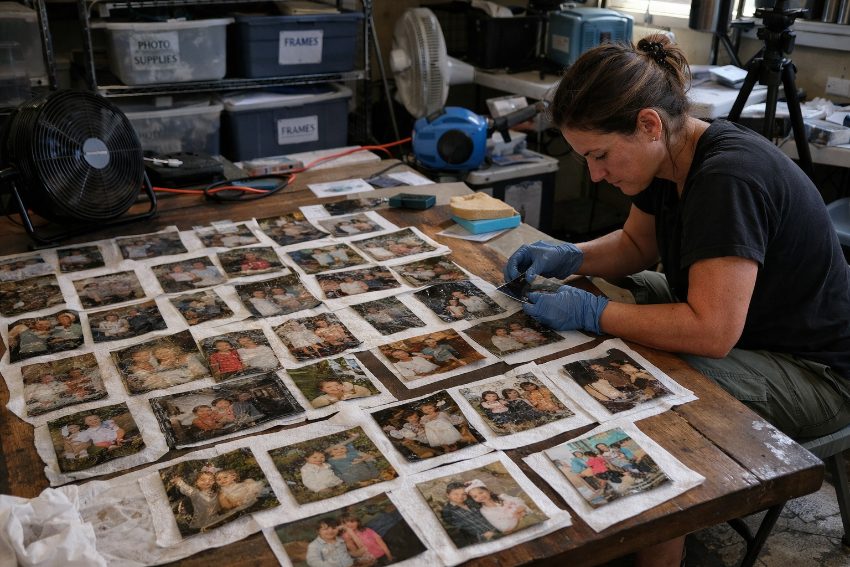
Recovery work happens before transfer: a damaged shell is opened, the tape is cleaned or spliced, then played on a deck with time base correction.
Moldy tapes can be cleaned, snapped tapes can be spliced, and tapes with partial signal loss can still be transferred to provide a watchable copy, because professional equipment such as a time base corrector can pull a very stable picture from the remaining signal on a deteriorating tape.
"The tapes people assume are dead usually are not," says Zachary Goldberg, owner of Forever Studios. "We transfer tapes every week that have not played since the nineties. What actually kills a recording is waiting another decade, or running a fragile tape through a forty dollar garage sale VCR."
What no process can recover is signal that has fully faded. No amount of money can get back what has been lost over time. Every year of waiting trades away picture quality that cannot be bought back.
Should you digitize your tapes yourself or use a professional service?
A consumer quality video archive is a collection of digitized video tapes. As these tapes were recorded by you, they can be damaged during playback. The risk of damage and the cost of replacement, however, increases with the value you place on the recording. To transfer your tapes to digital video yourself, you will need a VCR, a capture device (e.g. USB), and software to record the video from your capture device. Most VCRs play back video in real time, i.e. a 3 hour video will take 3 hours to transfer to your computer. As the consumer quality video tapes recorded with your camcorder grow older, they will deteriorate. The tapes themselves will become brittle and crack. As the tapes shed pieces of tape, these can stick to the VCR’s playback heads. In the worst case, this can cause serious damage to your VCR, so that you will no longer be able to play back your precious video tapes. For such video tapes, many professional archivists offer video tape transfer services. These services can transfer your tapes to digital video for you. As with any service, you will be charged by the transfer service for the transfer, and there will be a time period during which you will receive the transferred videos (turnaround time). The quality of the transferred videos can also vary from service to service. In general, it is less expensive to have your tapes professionally transferred than to risk damage to your VCRs and to lose your precious recordings.
"Most of the damage we see did not come from age alone," says David Jacobs, lead media transfer technician at Forever Studios. "It came from a good tape being run through an old VCR that had not been cleaned in twenty years. One bad pass can do more harm than another decade in a closet."
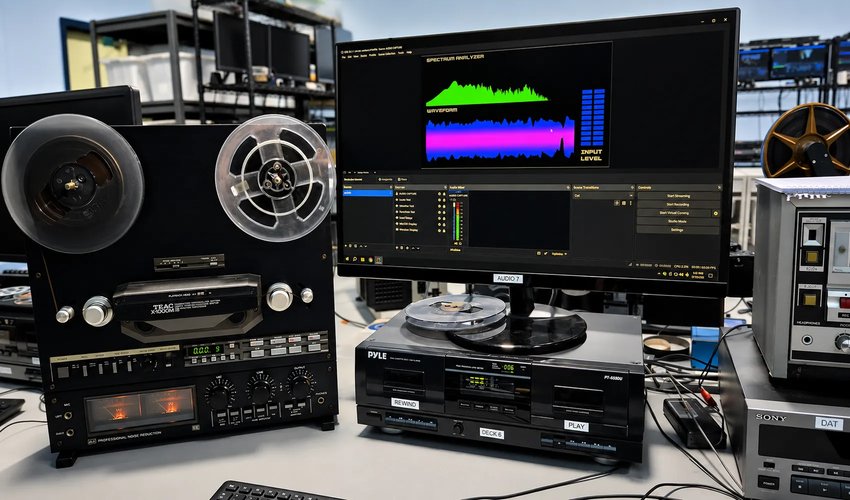
To transfer your tapes there are also many professional video transfer services available, where each tape is played in to check for sheds etc. and any decayed tapes repaired before transfer. Professional video transfers are played back onto a high-end broadcast deck using a time base corrector. All tracking, gain and noise reduction is then automatically set and monitored during the transfer. After transfer each tape is re-checked for decay, wear and shedding before being packaged up and sent to the client.
What format should you save your tapes to, and how do you keep them safe?
After digitizing all of your tapes, you will have to decide what to do with the resulting files of video. Preserving the video will mean storing it in a suitable format, and then storing that format for many years. This format is currently MP4 files, encoded with the H.264 codec, and play very well on current smart phones, computers, and current TVs. Because the quality of VHS video is generally far below that of current video, there is no need to export the digitized VHS into 4K or other high resolution formats. The files will be of adequate size (for large quantities of video) and quality to play back well on any current device.
Now that the tapes have been digitized, the last piece of the preservation puzzle to think about is how to store the resulting digital files. A single thumb drive or a single computer do not make for a good storage plan. A single hard drive does not make for a good storage plan. Three copies of the files on two different types of media is a good storage plan. So if you made a copy on a hard drive, make a copy on a solid state drive. Make an on-line copy in a cloud account. Make a copy and store it on a drive at a relative’s home. Once you have a digital file that has been preserved in this manner, it is no longer subject to expiration.
How much does it cost and how long does it take?
How much does it cost to digitize your videos? What is the time frame for digitizing your video tapes? Typically the cost for digitizing your video tapes is per video tape not per hour of video. The average turn time for digitizing a video tape is 1-2 weeks. Because the cost to digitize your video tapes is a fixed cost and that cost will increase every year it is best to digitize your video tapes as soon as possible.
What should you do with your tapes this year?
Start by listing all of your tapes at home, in order of importance. The irreplaceable videos come first: the recordings of your children or grandchildren that you cannot make again, the family events that cannot be re-staged. Recorded TV broadcasts come last. Look at your cassettes through the cassette window for any obvious signs of mold or uneven winding. Remove your tapes from garages, attics and storage units and store them in the coolest, darkest interior of your home.
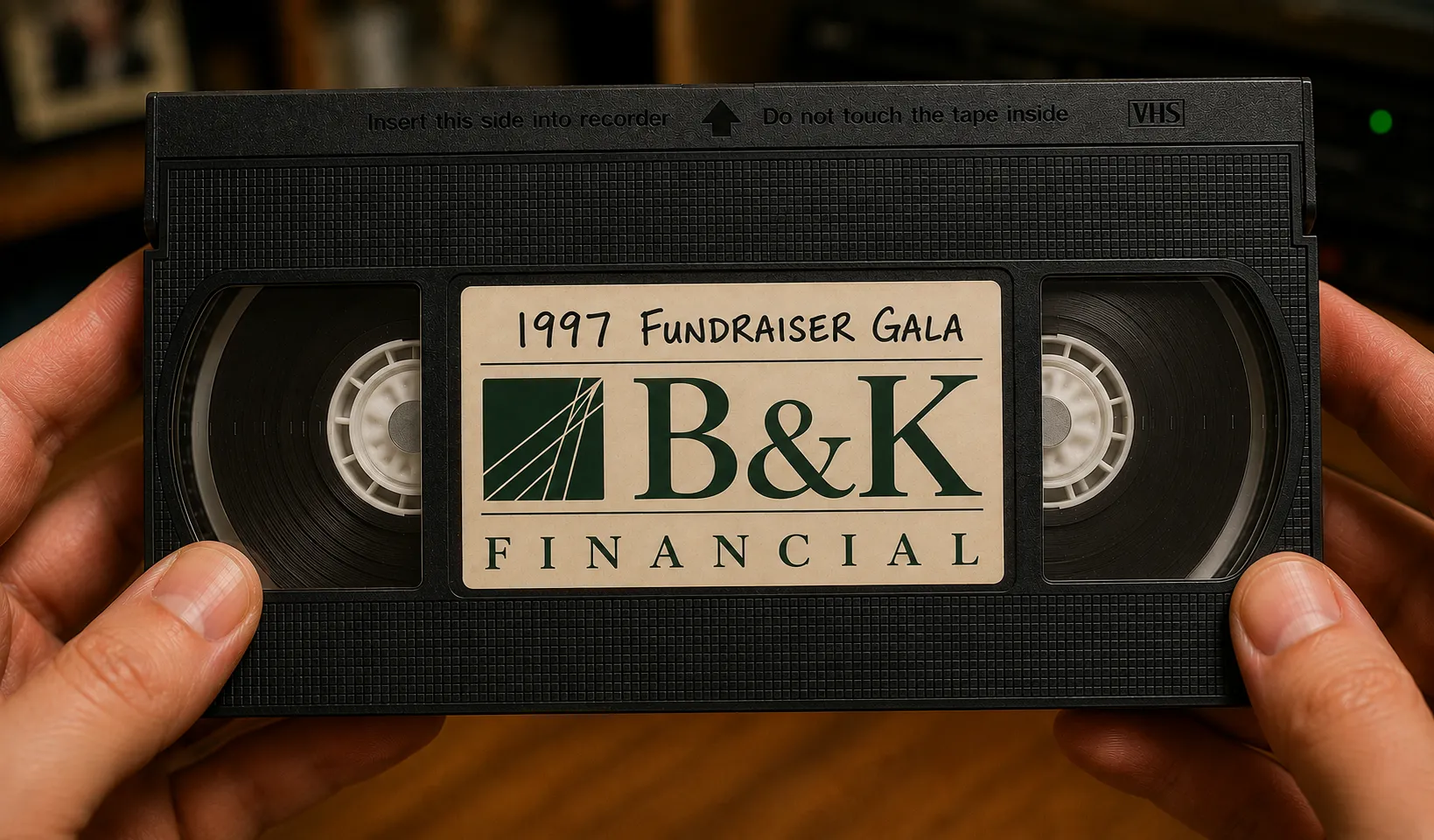
An inventory starts with reading labels and ranking what cannot be re-recorded.
Then transfer the irreplaceable tapes first, this year rather than a few years from now when they may have deteriorated past the point of playback. The window is closing on three fronts at once, and the tape's age is the one factor you cannot control.
Forever Studios, a professional photo and video preservation studio in South Florida, has digitized hundreds of thousands of family tapes, films, and photos. Our media digitizing service handles VHS, VHS-C, Hi8, MiniDV, Betamax, and film reels, including fragile and damaged tapes that need cleaning, splicing, or baking before transfer. If your tapes have been waiting in a closet since the nineties, they have waited long enough.
What customers say after getting their tapes back
Forever Studios holds more than 3,900 reviews across Google and Reviews.io, averaging 4.97 on Reviews.io with 100% of reviewers recommending them, and the tape transfers are a large part of that. A few in the customers’ own words:
“Our VHS tapes transferred to CD and USB were amazing. The VHS tapes were from 1989 thru 1994. The copies were all great and allow us to view cherished memories we thought were all gone. Process to order and ship was easy and straight forward. Thanks again for quality work.”
Jeffery, verified Forever Studios customer ★★★★★
“I was slightly anxious to be shipping family memories, but the staff stayed in contact, letting me know the progress all along the way, and completed 22 videos in just over a month. Very pleased with the quality and will definitely be sending more VHS tapes their way.”
Terri, verified Forever Studios customer ★★★★★
“Sent nine VHS tapes; all came back perfectly and in a timely manner.”
Krosby, verified Forever Studios customer ★★★★★
You can read more of these on the Forever Studios reviews page.

Ready to digitize it right the first time?
Bring your tapes, film, and photos to the team that treats every project as irreplaceable. All work is handled in-house in Boca Raton, never outsourced.