Famous American Presidents Restored & Colorized - William Henry Harrison
Explore the life of William Henry Harrison, 9th U.S. President, famed for his military feats and brief presidency.
Contents
Hello fellow history buffs and art fans, and welcome back to our Vintage University Blog for the second in our series of articles restoring and colorizing the American Presidents! In our previous article, our Lead Artist of the Forever Studios Restoration Studio restored and colorized what is probably the most famous portrait of Andrew Jackson. We also talked about some of what made Jackson such a uniquely influential president.
So for this edition of the presidential photo restoration series, we’ve decided to go a different direction, and pick someone just a bit less influential. In fact, it is pretty commonly understood that today’s subject, William Henry Harrison, is the least noteworthy president in our history. And if you don’t know why that’s the case, get ready for one very bizarre and very interesting story.
Restoring The American Presidents with Forever Studios: William Henry Harrison.
William Henry Harrison, like many of our early presidents, had himself a “catchy” nickname. Known as “Old Tippecanoe”, he got his nickname by being something of a war hero prior to becoming president.

An 1889 Painting of the Battle of Tippecanoe. One of Harrison’s Finest Hours.
In fact, Harrison was a really accomplished man who had a number of noteworthy accolades and contributions to the country. But all of that tends to be buried under the main “factoid” that people know about him.
William Henry Harrison’s presidency lasted exactly one month before he died.
The Portrait of Harrison We Chose to Work On.
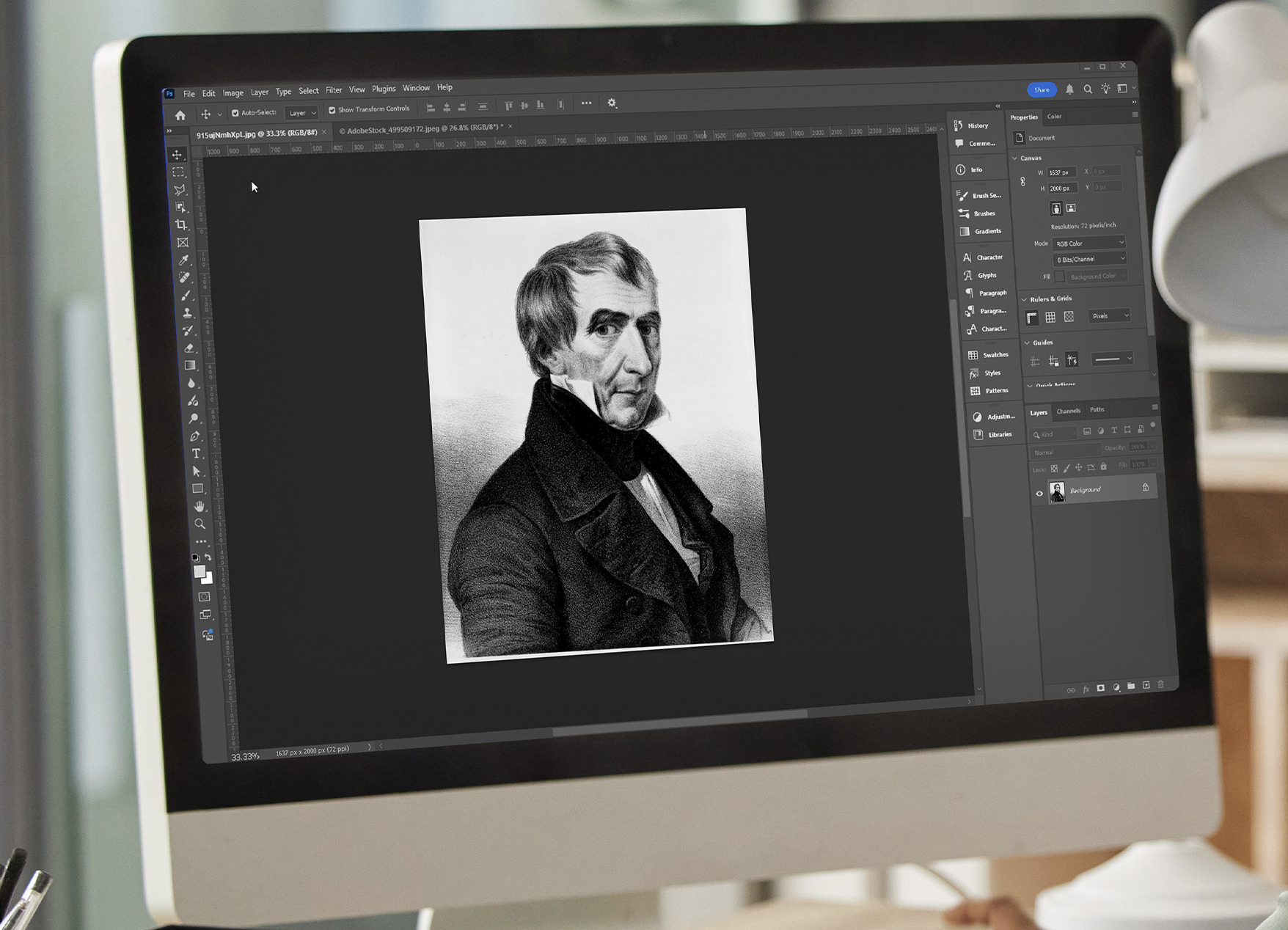
Before we get into the discussion of Harrison’s oddly short presidency, and how it came to pass, let’s look at the image we chose for Olivia to work on for this article.

Now THIS photo is a perfect candidate photo for old photo restoration.
This particular Daguerreotype photograph is the best known “photograph” of William Henry Harrison, but there’s actually a number of really serious questions about it that we still don’t have answers to today. Most notably, is it actually a photograph of President Harrison at all?
It’s been said that Harrison was the first president to ever be photographed, having sat for a Daguerreotype photo on his inauguration day. But many suggest that the photo you see here is NOT that photo, and that the photo in question is currently “lost media”. As a matter of fact, there is a painted portrait of Harrison which appears almost identical to this photograph, which has prompted people to speculate as to which one came first.
It’s actually hard to say whether the portrait was based on this photograph, or if the photograph is simply a picture of that portrait. Chances are, we won’t be getting a straight answer on this mystery any time soon.
WHY WE CHOSE THIS PARTICULAR IMAGE
Regardless of the provenance of this photograph, one thing is for certain: It’s a perfect subject for showing off what Forever Studios can do with our Photo Restoration service.
Most of the age related defects that could possibly affect a historical photograph like this are present here to some degree. Daguerreotype photographs are unfortunately known for having trouble standing the test of time, simply due to the very nature of how they were created. There are so many environmental factors that affect the materials and chemicals used for these types of photos, that it has been a real challenge to keep the existing ones from fading away completely or tarnishing beyond recognition.

There’s no Worse Feeling than Seeing Historical Imagery Literally “Fade Away”.
Nothing that’s 150 years old or more is going to be perfect, but preservation is extra difficult when heat, cold, moisture, sunlight & more all drastically affect the aging process.
More About the Forever Studios Restoration Process.
At Forever Studios, our team of restoration artists has a pretty extensive track record of working on the restoration of historical imagery. As a matter of fact, our Forever Studios Pro Services department regularly works directly with historical societies and museums on some of their most sensitive materials.
When our customers come to us, their photos are worked on by teams of professionals working under the direct supervision of these senior artists. No one project is an “island”, so to speak.
For a really in-depth look at how this process works, why not read our first article in the series on Andrew Jackson?
Taking a Look at The Finished Restoration.
It only takes one look at the finished restoration & colorizing job to see that it requires a great deal of work and attention. There are actually a number of different techniques that go into getting a result that looks this good, and not all of them have to do with art. A lot of them have to do with research.

Old Tippecanoe is looking pretty dapper in this restored image.
The fact is, you could be the best artist in the world, with the best technical skills, and if you don’t have the knowledge to nail historical work, it just won’t look right. The best practitioners of historical old photo restoration or black and white photo colorization have to be part historian and part artist.
Things as specific as knowing what materials clothes were typically made out of at the time, and what colors were most likely to be used for particular articles of clothing, is required knowledge. And in many cases for things such as the complexions or hair colors of historical figures, it requires consulting with primary information sources. AI and photoshop can only go so far.
All of this comes into play with a figure like William Henry Harrison here, who was a modern enough figure to photograph, but not in color. References have to be made to portraiture work, as well as contemporary accounts of what he actually looked like. Whenever our restoration artists here at Forever Studios are working on the colorization of historical work, research is a very large part of getting the job done right.
Understanding William Henry Harrison as More Than Just “The President Who Died Immediately”.
While you’re here, why don’t we chat a bit more about Mr. Harrison? He deserves to be remembered for more than just the odd circumstances of his death, because he deserves to be more than just a footnote in American History.
If you’re not familiar with the story of his election and his passing, it goes like this:
Harrison, in his second attempt at a presidential run, managed to defeat the incumbent Jacksonian Democrat Martin Van Buren, denying him a second term as President of the United States, in the 1840 election.
Harrison had actually run against Van Buren in the previous election in 1836, but the Whig party (in a strange attempt to game the electoral college against the insurgent Jacksonian Democrats) had run 4 different candidates regionally, with Harrison being one of the four.
THE ELECTION OF 1840 & HARRISON’S INAUGURATION DAY.
While that gambit in 1836 hadn’t worked out, Harrison managed to defeat Van Buren in 1840 as the sole Whig party candidate.
Despite being fairly old during the 1840 election, Harrison made trips all over the USA to campaign, and people came out in droves to see him. In some cases, tens of thousands of people would come out to Harrison’s rallies, and the turnout for the 1840 election was a rather remarkable 80% of the voting eligible public.
William Henry Harrison came into the White House as a president-elect that people were genuinely excited about. And so, for his inauguration, Harrison had prepared the longest inauguration speech in American Presidential history. It remains the longest to this day.

Harrison’s Inauguration was Truly a Spectacle to Behold.
Harrison spoke at length about every aspect of what he would do as president. Every policy position and plan was laid out in meticulous detail. He spoke at length about his philosophical understandings of proper American leadership, and the role of the president in the American system of government.
THE CIRCUMSTANCES THAT LEAD TO THE DEATH OF WILLIAM HENRY HARRISON.
The only problem is that inauguration day was a very cold and wet day, and Harrison chose to spend the entire day lightly dressed and exposed to the elements. He took a tour riding on horseback on his way to the inauguration, then delivered his speech for over two hours. After that, he again rode on horseback through Washington D.C. with the inaugural parade, and then held a reception for the public back at the White House that took another 3 hours.
Once he finally finished these activities, he attended three separate inaugural balls. And Harrison did all of this as a well worn 68 year old man. That’s 68 in 1840, a very different 68 years old.

A Lithograph of Harrison’s FInal Moments, on April 4th, 1840.
His schedule did not abate much after inauguration day, and Harrison seemed to overwork himself constantly from that point forward. The rest, as they say, is history. After about 3 weeks of this crazy schedule, Harrison fell ill, was diagnosed with pneumonia, and passed away. He was president for just one month.
What Would Harrison Have Been Like as President Had He Survived?
All accounts point to the fact that WIlliam Henry Harrison likely would have been an effective and conscientious President of the United States. When it comes to experience in all the aspects that typically make for a good American president, Harrison pretty much had it all.
A GREAT LIFE OF PUBLIC SERVICE.
He was a respected Major General who served effectively in multiple wars. He was a two time member of the House of Representatives, a Governor, and also a Senator. He even served as a Foreign Minister to the nation of Gran Colombia at one point.
That’s not even mentioning the fact that he came from a lineage of great and respected leaders that not only traced back to the founding fathers of the United States, but further back to his original family home of England. He received nothing but the finest education and tutelage as a child, with the clear understanding that his role would be to be a leading member of government.

Perhaps not so Coincidentally, Harrison’s Grandson Benjamin Harrison would also Become President.
William Henry Harrison was effectively born to be President of the United States, and he fulfilled every objective laid out for him at every step of the way. Even his last words, which were understood to be directed at his Vice President John Tyler were “Sir, I wish you to understand the true principles of the government. I wish them carried out. I ask nothing more.”
It is probably fair to say that the United States likely missed out on a presidency that would have been rather remarkable.
What’s Next in Our Series on Presidential Photo Restorations?
Thanks for reading our article on William Henry Harrison, and we hope you look forward to the next article in this ongoing series. So who is next in line for the presidential photo restoration treatment? We’re thinking it would be a great idea to take a look at Ulysses S. Grant.
So far, we’ve been covering the controversial and interesting figures who have inhabited the White House, and we don’t see a reason to stop here. Grant may have been the hero who helped the Union win the American Civil War, but his presidency is one that people still hotly debate to this day. So it will be interesting to look at not only another expert photo colorizing project, but a presidency that had some very intriguing ups and downs.

Ready to digitize it right the first time?
Bring your tapes, film, and photos to the team that treats every project as irreplaceable. All work is handled in-house in Boca Raton, never outsourced.