Cassette Tapes to Digital: What You Actually Get (And What to Send Us)
A straight guide to converting audio cassette tapes to WAV and MP3: tape types, what equipment matters, file formats, cost, and how to prepare your collection.
Contents
- The cassette digitization process runs in real time: a 90-minute tape takes approximately 90 minutes to transfer
- Most tapes from the 1970s through the 2000s remain playable, though degradation is accelerating in older Type I (ferric) tapes
- WAV files preserve the full audio spectrum captured from the tape; MP3s are compressed but shareable
- The playback deck matters more than any other variable in the transfer chain
- Tapes should be rewound to the beginning, stored upright, and kept in their cases before being sent in for conversion
- The Library of Congress recommends converting analog audio recordings to digital within the next 10 to 15 years to avoid irreversible loss
Which Cassette Tape Formats Can Be Digitized?
All sorts of cassette tapes can be digitized, made as they were from the 1960s onwards up to the late 2000s. Typically, a cassette contains four audio tracks. Type I cassettes are made of ferric oxide and are generally sold for recording on in cassettes by the sort of person who does lots of recording on cassettes. Type II cassettes, on the other hand, are made of chrome/cobalt and have a high frequency response, so they are the sort of tapes that are generally used for music. Type III and Type IV cassettes, however, are made of metal, and they contain the highest quality audio of all the different tape formats. In fact, some audiophiles prefer the sound of their music on tape rather than as digital audio.
Home recordings can be really varied. We have people send us their old mixtapes from years gone by, band practice recordings, wedding speeches, voice messages of deceased relatives, church services, language courses, kids’ school recitals and even years of old voicemails left on an answering machine. Really anything recorded on a cassette that is special to someone can be recovered.
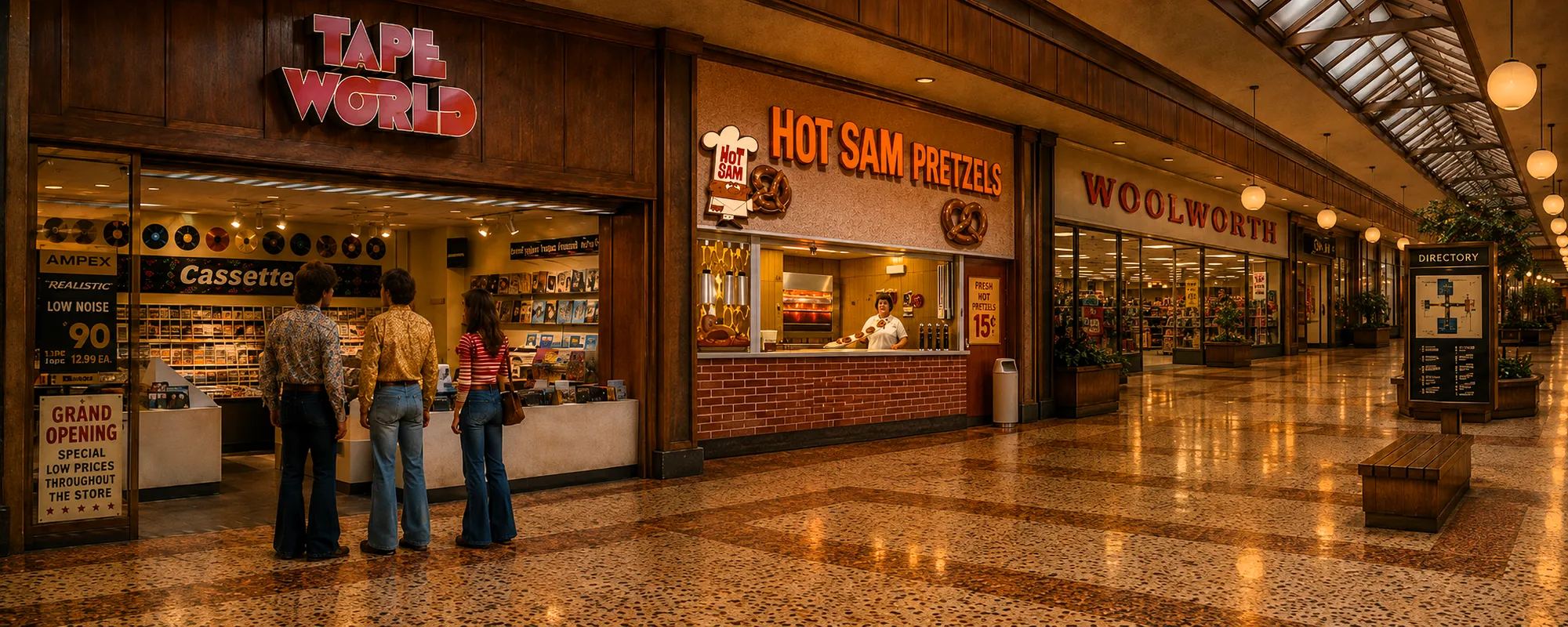
Cassette tapes were widely available through retail outlets before the digital conversion era began.
How Long Do Cassette Tapes Typically Last?
Cassette tapes can last longer than 30 years if stored properly. Store your cassettes in a cool, dry place. Store them upright to prevent them from bending. Also, store them away from strong magnetic objects. The Council on Library and Information Resources published a study in 2022 on the lifespan of many types of legacy magnetic audio tape. The study found that tapes stored between 18 and 21 degrees Celsius at 30 to 40% relative humidity will deteriorate at a much slower rate than tapes stored at room temperature.
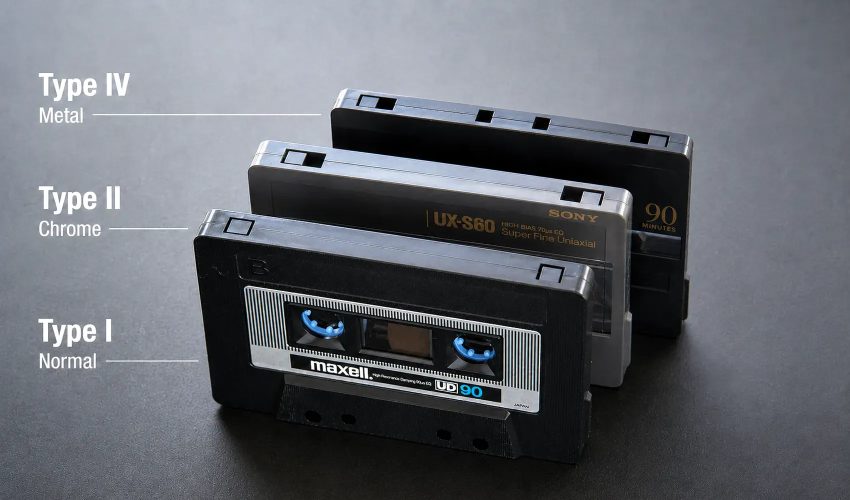
Different cassette tape formulations have varying lifespans and audio quality characteristics that affect preservation needs.
Cassette tapes can be stored in all sorts of less than ideal locations - garage containers, car dashboards, loft spaces etc. The binder in a cassette tape deteriorates much faster in such a storage location than it would in a cool, dry storage area. The binder in a cassette tape is the chemical that attaches the magnetic oxide particles to the plastic tape substrate. As the binder deteriorates it absorbs moisture from the air. When such a cassette tape is played back on a tape player, the magnetic oxide begins to flake from the surface of the tape. This can cause irreparable damage to the recorded information on the tape as well as to the tape player itself.
The most endangered media collections for archivists and collectors are the old analog Ferric (Type I) audio tape recordings of about 1970s vintage. Analog magnetic media, including audio, video and film, are a critical endangered material and are being urged to be digitized by the Library of Congress as soon as possible – within the next 10 years. This plea for action applies to personal collections as well as to archives of institutions.
"We tell customers that if a tape has been sitting undisturbed for more than twenty years, the transfer should happen now. Binder breakdown accelerates once it begins, and the window for clean capture narrows with every passing year. Tapes that play cleanly today may not play at all in five years. The chemistry is working against us, and there is no reversal process once oxide shedding begins."
Greg E., Preservation Specialist, Forever Studios
Why Is Professional Transfer Better Than USB Converters?
USB cassette converters to digitize tape look simple enough. Plug the converter into your computer, connect your cassette player, hit play and record the audio in the software provided with the converter. No need to send off your tapes to someone else and wait for them to be digitized for you. These little converters are inexpensive enough, for example to cost less than $40. But the quality of what comes out of your computer after you have stopped playing the tape is another matter entirely.
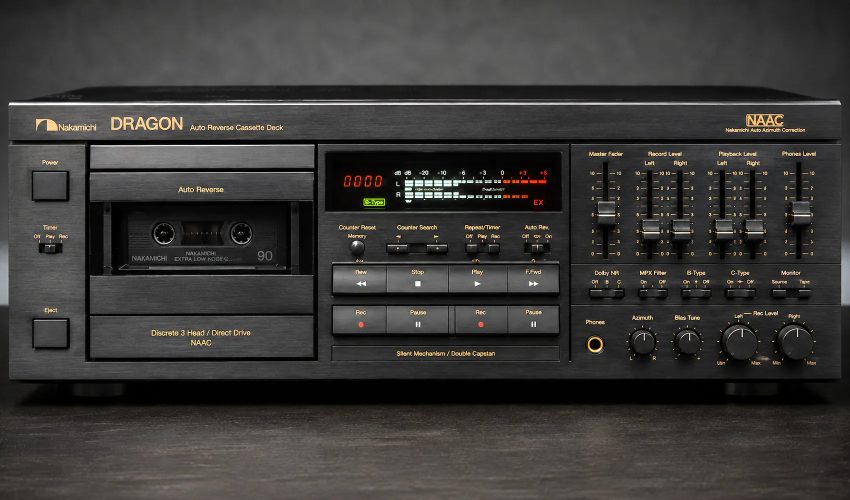
Professional cassette decks like this preserve tape fidelity in ways consumer converters cannot replicate.
The playback head on a consumer USB converter is a low tolerance part. It is sampling the audio at 8 or 16 bit. These units lack bias control, so they cannot compensate for the magnetic characteristics of different tape formulations. Chrome tapes require a higher bias setting than ferric tapes; metal tapes require a higher setting still. Playing a chrome tape on a head calibrated only for ferric oxide results in ferric stock introduces high-frequency distortion that makes the transfer sound flat and dull. This distortion is permanent.. Playing chrome tape on a ferric tape set head will result in high frequency distortion. The transferred sound will be very flat and lifeless. The distortion is irreversable, so it cannot be corrected after the transfer.
Professional studios use restored machines such as Nakamichi, Tascam multi-tracks and a host of Studer multi-tracks. The machines can be set up for the tape in question, and also have the option of Dolby B and C noise reduction applied during playback, should the original recording require it. The noise reduction removes hiss from the recording, which would normally be present on a copy of the recording. There is a world of difference between making a copy with say a $30 USB tape machine and making a real recording using a professional set up of machines and tape.
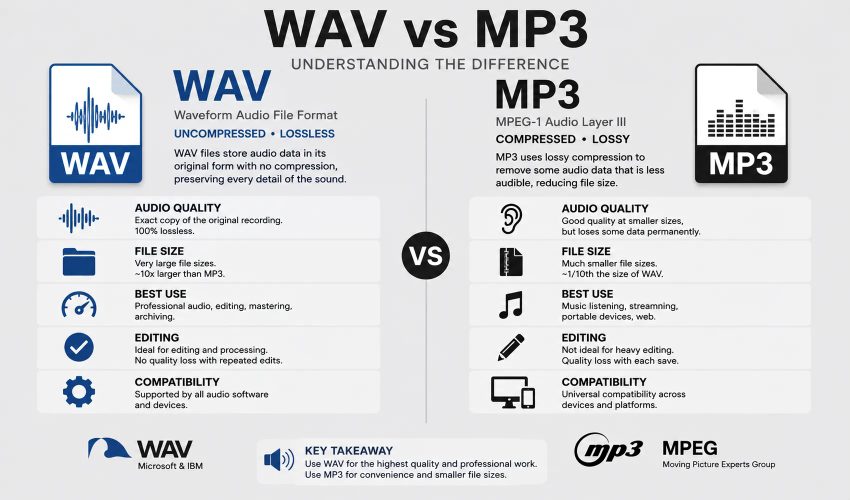
Professional digitization services typically deliver uncompressed WAV files that preserve the full quality of your original cassette recordings.
Forever Studios · Boca Raton, FL
Audio Transfer Service
Cassettes and reel-to-reel audio digitized to WAV and MP3.
LEARN MORE →Which File Formats Do You Receive After Transfer?
Professional cassette transfer generates 2 files per tape (WAV & MP3). The WAV files contain unloss-compressed audio, i.e. the ‘archival master’. These files are very large and an 90 minute stereo cassette would generate around 900MB of file space when transferred as 24-bit/48kHz stereo WAV files. These master files can then be edited, have noise removed from them, or be re‑formatted to other file types etc.
Here’s a 256kbps or 320kbps MP3 – downsampled and then psychoacoustically compressed to a very small file. This file is so small and so portable that it will play on any device. The objective of this kind of file was to be transparently perceptually compressed at these bitrates, and generally it is – most people can’t tell the difference between a 320kbps MP3 and the original, lossless file at typical listening levels.
Files are delivered to you in a digital format, as well as on CD if required. Depending on your chosen package, your files are available for download or preloaded on a USB drive. For customers that require a physical delivery of CDs, these are posted to you.
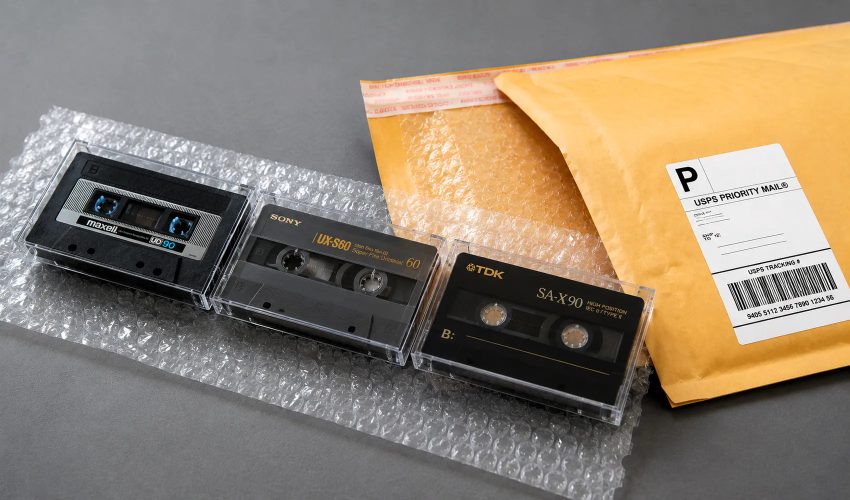
Proper packaging protects analog media during transit to our digitization facility.
How Should You Prepare Cassettes Before Shipping?
Three steps significantly improve the quality of the transfer and reduce the risk of a failed capture.
1) Before shipping off tapes to be digitized, make sure to rewind them to the “Beginning of Tape”. Tapes that have been left to play and then put away for long periods of time will have plenty of time to build up oxide shedding at the takeup reel of the tape. It is best to rethread the tapes from the “Beginning of Tape” for fresh threading.
2) Cassettes should be placed in their original cases. If no reel cases are available then individually wrapped in small inexpensive protective plastic sleeves. The reel cases will protect the tape from dust, and the tape edges on the reels from impact damage in the mailing of your reel collection.
Label information about program material and recording settings (such as Dolby A or B) is valuable to the transfer engineer, who can match playback head settings to optimize noise reduction during transfer.
Surface mold, strong vinegar smell, or broken leaders should be noted in the shipping documentation. Tapes with these issues may benefit from baking or splicing prior to transfer, services some studios offer for an additional fee.
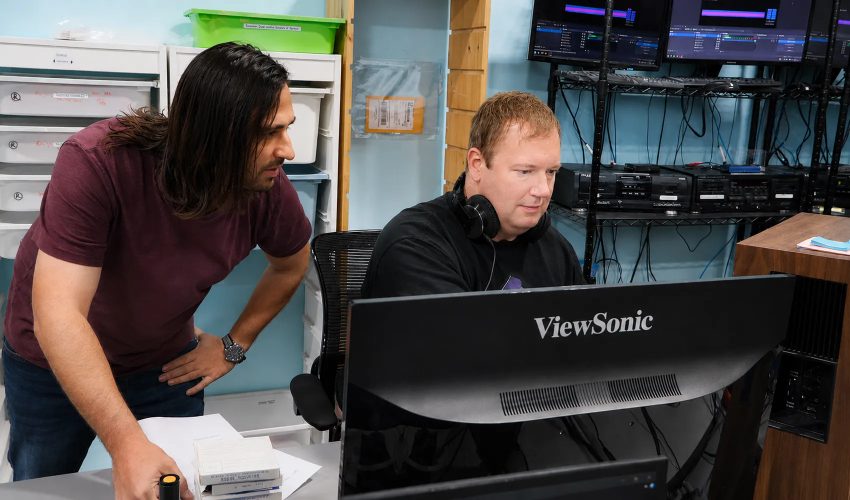
Our team carefully evaluates each tape before beginning the digital conversion process to ensure optimal results.
Forever Studios · Boca Raton, FL
Audio Transfer Service
Cassettes and reel-to-reel audio digitized to WAV and MP3.
LEARN MORE →What Happens When a Cassette Is Damaged or Unplayable?
Not all cassettes will playback or transfer as well as others. Due to the inherent nature of the cassette format there are some items that will not transfer well or at all. For example tapes with severe binder breakdown, torn leaders or worn oxide surfaces. As a professional studio we feel it is only fair to inform our clients of cassettes that are borderline and could fail at any time. Playing a cassette that is on the brink of failure through a deck can result in the loss of all information on the tape. Many of these problems can be addressed in certain ways. For example, cassettes affected by sticky-shed syndrome can sometimes be made stable enough for a single successful transfer using a low-heat dehydration process, such as a food dehydrator, for several hours. This temporarily removes moisture from the binder, allowing a single successful pass through the deck. Subsequent passes will probably cause serious damage to the recording.
Some forms of tape damage can be treated, rather than cured. For example, tape suffering from sticky-shed syndrome (where the binder has taken in so much moisture that the oxide begins to shed during playback) can be made playable for a single play and then a recording made off that play. The only treatment for this type of damage is to dry out the absorbed moisture. The tape is placed in a low-temperature food dehydrator for a few hours. Not all tapes can be stabilized in this way and even then the stabilization does not reverse the damage that has already been done to the tape.
Mold is contagious between tapes. If you have a tape with visible mold please keep it isolated from the rest of your collection. When we receive a large shipment of cassette tapes please make sure to note the tapes that appear to have mold on them in the packing slip info so we can treat them as a separate item.
How Much Does Cassette Digitization Typically Cost?
Cassette Tape Digitization Prices: $15 per tape. Forever Studios will supply the digitized files in WAV and MP3 format and go through the tapes for noise, etc. within the standard processing time; note that each tape with separated tracks (i.e. alternate versions or remixes) will be digitized as separate tracks. 90 min. tape and 30 min. tape are the same price – $15.
For reference, the national average for professional cassette digitization is $12 to $20 per tape. This can be provided as files or on DVD or hard drive. Note that lower prices usually mean lower quality equipment or that your tapes are being sent to someone else to transfer. Higher prices mean they are offering additional restoration such as correcting for speed drift and equalizationn.
Professional cassette digitization services pricing for projects across the United States typically begin at around $12 per tape and go up to as high as $20+ per tape. Here at that low price point, it is common to find very low cost, possibly poor quality equipment and/or the actual tape to digital transfer outsourced to a 3rd party by the low cost vendor. In higher‑priced services, they can deliver enhanced audio restorationo restoration on the recordings, for example, they might have to set the recording back to the correct speed that it was recorded at, and equalize it for best playback.
Forever Studios, a South Florida full service media preservation studio, serves clients from all over the USA. Their audio cassette conversion service will accept all of the standard forms of cassette and return your files in 2 to 3 weeks.
★★★★★
"The transfer of my cassette tapes to digital format was great. After 30 plus years it was wonderful to hear my great-grandfather singing again. Your communication throughout the process was excellent. I look forward to doing more business with you in the future."
BRIAN, verified customer review
How Do You Start Digitizing a Cassette Collection?
When you first pull out your stacked cassettes from a box, it can be difficult to know exactly what you have. By first taking an inventory of your tapes, you can start to get a sense of your collection. Begin by writing down the label of the tape, if it has one. If the tape is blank and has no label, note the brand of the tape and its length. Also, take note of any tapes that appear to have been damaged in some way. Doing an initial inventory of the tapes you thought you had will likely reveal cassettes that you had long forgotten that you even had. Many of these cassettes will contain recordings that cannot be replaced.
What if I don't know what's on the tapes I'm sending?+
That is pretty typical for our customers. They often send cassettes that are unlabeled, perhaps the person who created the tapes has a vague idea of what is on them. When we set up a project to digitize tapes we listen to a sample from the start of each tape to ensure the tapes are playing back okay and to get a sense of the content, especially if the tapes have not been labeled well. So, for example, a tape that contains 3 songs, completely unrelated to each other and spread over both sides of the tape, would be set up as separate tracks for the project and labeled to describe the content of each track.
How long does it take to digitize a cassette tape?+
Our lab is able to dub a 90 minute tape in approximately real time. Professional studios typically list turnaround time as 2–3 weeks. This time includes processing the work, quality control, making the files, and then notifying the customer that the work is complete. Rush service is available for an additional fee; standard turnaround also has built‑in quality control a list of studios and their current work load.
Can I digitize cassette tapes myself at home?+
Yes, you can digitize cassettes by using a USB cassette converter or by connecting a cassette deck to a computer via an audio interface. For making listening copies, home digitization can be sufficient; for archiving and restoration, however, professional transfers are far superior. Home playback heads are not bias’d for different types of tapes and even good quality decks are often captured at 16-bit instead of 24-bit. For a one-off recording on a single tape that cannot be re-duped, it is best to have a professional transfer done to minimize capture errors and problems with the equipment used for the transfer.
Forever Studios catalogs and identifies unlabeled tapes during the transfer process, so you receive a complete inventory of your audio collection.

Ready to digitize it right the first time?
Bring your tapes, film, and photos to the team that treats every project as irreplaceable. All work is handled in-house in Boca Raton, never outsourced.