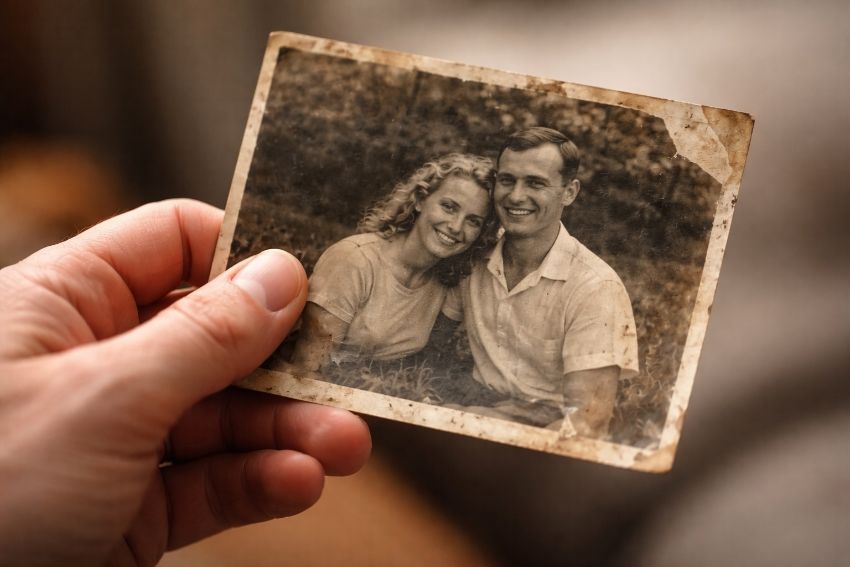
<p style="text-align: left;">Most people think photo restoration is a button. You upload an image, something inside an AI software “fixes it,” and a cleaner version comes back. That model exists. It’s fast. It’s convenient. And in some cases, it’s good enough. But it’s not what photo restoration actually is, at least not when the photo matters.</p> <p style="text-align: left;">If you’ve ever sat with an old photograph long enough, you start to notice something. The damage isn’t just damage. It’s interference that gets in the way of something important that used to be clear. And once you see that, the job changes.</p> <p style="text-align: left;"> </p> <h2 id="the-real-job-of-photo-restoration-isnrsquot-to-just-mechanic" style="text-align: left;"><strong class="anchor">The Real Job of Photo Restoration Isn’t to Just Mechanically “Fix” a Photo</strong></h2> <p style="text-align: left;"> </p> <p style="text-align: left;">It’s figuring out what the photo’s supposed to be.</p> <p style="text-align: left;">Most people don’t think about it this way, but once you do, it becomes obvious. You’re not just cleaning something up. You’re trying to get back to something that already existed, even if parts of it are gone.</p> <p style="text-align: left;">Where most restoration goes wrong is right here.</p> <p style="text-align: left;"> </p> <p style="text-align: left;"><img style="width: 850px; height: auto;" src="https://memoya-production.s3.amazonaws.com/images-blog/1991b1cb-14af-4df1-991b-dfdcebbcbeff.png" width="850" height="567"></p> <p style="text-align: left;"><em>Yes, there is a technical job that needs to be done correctly to fix a photo like this. And yes, the latest advanced AI models can reliably “fix” something like this and un-do the damage. But what an AI can’t quite understand yet are the emotional reasons why certain details are non-negotiable. It can’t “feel” the reason why something requires specific attention the way another human can.</em></p> <p style="text-align: left;"> </p> <p style="text-align: left;">The market tends to treat restoration like either a magic trick or a basic cleanup service. Either AI handles everything, or someone manually removes scratches and adjusts color. Both approaches miss the hardest part.</p> <p style="text-align: left;">Because the real challenge isn’t removing damage. It’s avoiding the introduction of something that doesn’t belong.</p> <p style="text-align: left;"> </p> <h3 style="text-align: left;"><strong>A Restoration can Look Sharp, Vibrant & Technically Better… And Still be Wrong</strong></h3> <p style="text-align: left;"> </p> <p style="text-align: left;">You’ll see it in subtle ways:</p> <p style="text-align: left;">Faces that feel slightly off.</p> <p style="text-align: left;">Details that look filled in instead of real.</p> <p style="text-align: left;">Colors that are clean, but not accurate.</p> <p style="text-align: left;">Things that were guessed at instead of understood.</p> <p style="text-align: left;"> </p> <h3 style="text-align: left;"><strong>The Best Photo Restoration Work Preserves the Human Connection to Reality</strong></h3> <p style="text-align: left;">The moment you notice one of these elements that don’t quite land properly, the whole image tends to break in terms of perceived realism. Because it doesn’t feel like the person or moment anymore. That’s why this isn’t just a technical process. At a certain point, restoration becomes a translation problem. The customer knows things the image doesn’t anymore.</p> <p style="text-align: left;"><img style="width: 850px; height: auto;" src="https://memoya-production.s3.amazonaws.com/images-blog/19e60e53-5ebc-4e5f-93e8-5686bb0e4e61.png" width="850" height="567"></p> <p style="text-align: left;"><em>Does the finished image on the right look good in a technical sense? Yes, and most AI generated imagery these days does. But if this was your mother or grandmother, the fact that it no longer appears to be the same person is a pretty big deal. And no amount of AI prompt work is going to fix that very important problem.</em></p> <div class="article-in-ad-block"><img class="article-in-ad-block-img" src="https://memoya-production.s3.amazonaws.com/images-blog/1991b1cb-14af-4df1-991b-dfdcebbcbeff.png" alt="Professional photo restoration by Forever Studios"> <div class="article-in-ad-block-data"> <h2 id="professional-photo-restoration" class="article-in-ad-block-title">Professional Photo Restoration</h2> <span class="article-in-ad-block-description">Transform your damaged, faded, or torn photos into beautifully restored memories. Our expert team combines advanced technology with artistic skill for results AI alone cannot achieve.</span><a class="article-in-ad-block-btn" style="text-align: left;" href="https://foreverstudios.com/enhance-editor/?typeProduct=photo_restoration">GET STARTED</a></div> </div> <p style="text-align: left;"> </p> <p style="text-align: left;">That could be what their mom’s eyes actually looked like, or whether a certain car paint was flat or metallic.</p> <p style="text-align: left;">What’s actually important is how something felt, not just how it looked.</p> <p style="text-align: left;"> </p> <h3 style="text-align: left;"><strong>Translating Emotional Understandings into Proper Visual Arts Results</strong></h3> <p style="text-align: left;"> </p> <p style="text-align: left;">Most of the time, the most critical information doesn’t come in clean. It comes in fragments. It comes emotionally. And most people don’t have the language to describe it precisely in terms of how that translates to a photo restoration project. So the job becomes extracting that information, interpreting it correctly, and turning it into something an artist can actually execute.</p> <p style="text-align: left;">A real restoration process usually starts the same way:</p> <p style="text-align: left;">High resolution scanning.</p> <p style="text-align: left;">Initial cleanup.</p> <p style="text-align: left;">Color correction.</p> <p style="text-align: left;"><img style="width: 850px; height: auto;" src="https://memoya-production.s3.amazonaws.com/images-blog/85cb5c9c-4e42-496b-88b3-2c33b59f9152.png" width="850" height="567"></p> <p style="text-align: left;"><em>Even though professional photo restoration is becoming increasingly more “science” than “art” as time goes by, it doesn’t mean that the human part of the equation isn’t still responsible for some of the most important decisions that get made during the process.</em></p> <p style="text-align: left;"> </p> <p style="text-align: left;">But that’s just the foundation. The real work starts when decisions have to be made.</p> <p style="text-align: left;">“<em>What can we trust in the image, and what can’t we?</em>”</p> <p style="text-align: left;">“<em>What’s been lost, and what needs to be rebuilt?</em>”</p> <p style="text-align: left;">“<em>What’s a safe adjustment, and what requires interpretation?</em>”</p> <p style="text-align: left;"> </p> <h3 style="text-align: left;"><strong>Making the Important Decisions for a Photo That AI Can’t Help With (Yet)</strong><strong><br><br></strong></h3> <p style="text-align: left;">Sometimes, you hit a point where continuing means making a call that isn’t purely technical. That’s where a good system stops. Instead of guessing, the photo restoration team from Forever Studios reaches out. We ask questions and make sure to understand the details that only another person would understand the importance of.</p> <p style="text-align: left;">“<em>Tell us about your mom’s eyes.</em>”</p> <p style="text-align: left;">“<em>Was that finish matte or metallic?</em>”</p> <p style="text-align: left;">“<em>Do you have another photo from around this time?</em>”</p> <p style="text-align: left;"> </p> <p style="text-align: left;">Because the goal isn’t to make something that looks good. It’s to make something that’s correct. AI has made parts of this process faster and more accessible. It can clean things up, sharpen details, and even suggest what might belong in a missing area. But it has a hard limit.</p> <div class="article-in-ad-block"><img class="article-in-ad-block-img" src="https://memoya-production.s3.amazonaws.com/images-blog/85cb5c9c-4e42-496b-88b3-2c33b59f9152.png" alt="Expert photo restoration services at Forever Studios"> <div class="article-in-ad-block-data"> <h2 id="restore-your-family-photos-today" class="article-in-ad-block-title">Restore Your Family Photos Today</h2> <span class="article-in-ad-block-description">From cracked wedding portraits to water-damaged family snapshots, our restoration specialists bring your most cherished photos back to life with precision and care.</span><a class="article-in-ad-block-btn" style="text-align: left;" href="https://foreverstudios.com/enhance-editor/?typeProduct=photo_restoration">LEARN MORE</a></div> </div> <p style="text-align: left;">It doesn’t know what you know.</p> <p style="text-align: left;"> </p> <h2 id="the-current-limits-of-ai-generated-photo-restoration-softwar" style="text-align: left;"><strong class="anchor"><strong>The Current Limits of AI Generated Photo Restoration Software in 2026</strong></strong></h2> <p style="text-align: left;"> </p> <p style="text-align: left;">The average AI system in 2026 can cleanly generate a representation of what something should look like in general, but it can’t know what’s right for your specific image. It doesn’t have your history. It doesn’t have your context.</p> <p style="text-align: left;"><img style="width: 850px; height: auto;" src="https://memoya-production.s3.amazonaws.com/images-blog/58fc8d49-e373-4a42-a9ba-1f1c9d66b58d.png" width="850" height="567"></p> <p style="text-align: left;"><em>Here’s a quick example of what it looks like when it’s left to AI alone to fix a historical image. It might be able to clean up most of the image, but without clear references for the small details that make a person look right, the end result can be pretty uncanny looking.</em></p> <p style="text-align: left;"> </p> <p style="text-align: left;">That’s where a human becomes necessary. Not just to operate the tools, but to make the call. And that carries into the revision process too. A lot of people assume there’s a single correct version that just gets delivered. In reality, restoration projects with a professional provider like Forever Studios are often iterative.</p> <p style="text-align: left;"> </p> <h3 style="text-align: left;"><strong>The Benefits of Working on Multiple Revisions as Part of a Collaborative Process</strong></h3> <p style="text-align: left;"> </p> <p style="text-align: left;">Most projects that we work on at FS get approved on the first pass. But when they don’t, it’s usually because the last 10% needs to be dialed in just right. And that part almost always requires collaboration. A customer might say, “something feels off,” without knowing exactly what it is. Our job is to translate that into something actionable.</p> <p style="text-align: left;">We go through the work of taking something emotional and turning it into a technical adjustment that gets us closer to the right answer. Because we don’t see this as a product. We see it as historical preservation.</p> <p style="text-align: left;">That changes how you approach everything. You don’t stop when it looks better. You stop when it feels right.</p> <h2 id="what-truly-constitutes-a-ldquoperfect-resultrdquo-when-it-co" style="text-align: left;"><strong class="anchor"><strong>What Truly Constitutes a “Perfect Result” When it Comes to Restoring an Old Photo?</strong></strong></h2> <p style="text-align: left;"> </p> <p style="text-align: left;">The way we’ve always seen it, when done properly, the best restorations don’t look restored at all. They just look like the photo was always intact. No visible work. No overcorrection. No artificial feel. Just a photograph that still belongs to the moment it came from. And that’s really what you’re choosing when you decide who to trust with something like this.</p> <p style="text-align: left;"><img style="width: 850px; height: auto;" src="https://memoya-production.s3.amazonaws.com/images-blog/3a6a12d4-1b8a-49cf-921c-5005ea06fd09.png" width="850" height="567"></p> <p style="text-align: left;"><em>There’s a certain unique sense of satisfaction that comes from receiving a really well done photo restoration. It’s a piece of your history after all.</em></p> <p style="text-align: left;"> </p> <p style="text-align: left;">You’re not choosing software. You’re choosing how decisions get made. How uncertainty gets handled. Whether someone’s going to guess, or whether they’re going to take the time to understand. Because once it’s done, that version becomes the one that gets shared, printed, and remembered going forward.</p> <p style="text-align: left;">And if it’s wrong (even slightly) that’s the version that sticks.</p> <p style="text-align: left;">That’s what makes the art of photo restoration more than just an exercise in fixing damage. Even with the most modern tools out there, the craft that surrounds the work is still about human understanding at its core. That understanding is why the team here at Forever Studios is still doing it in a way that respects both what actually existed, and what it means to the person holding the photo.</p> <p style="text-align: left;"> </p>